
Reflections from Northwestern University's COP31 Delegation: Day 4
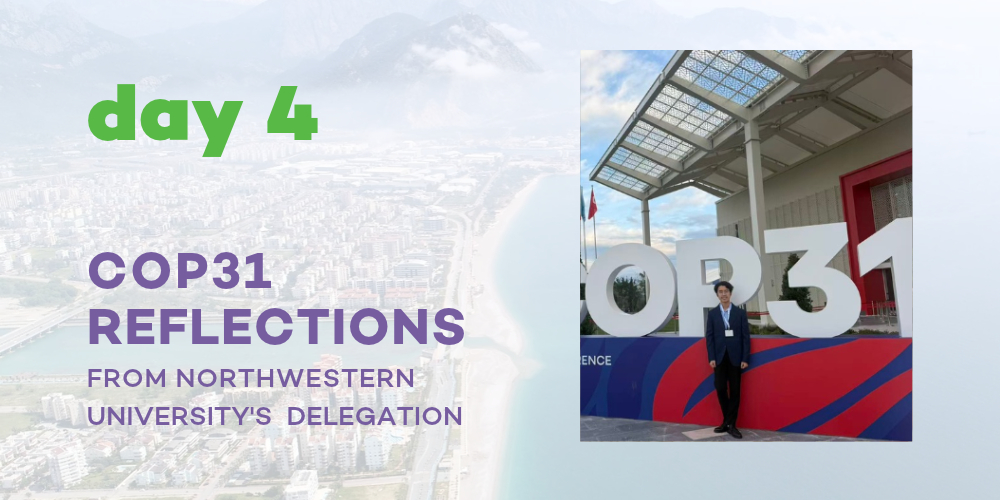
 For a sixth year, a delegation of Northwestern University students and faculty supported by the Roberta Buffett Institute is among more than 92,000 researchers, policymakers, industry leaders, and activists at the world’s largest annual international treaty negotiations and climate summit, the 31st Conference of Parties (COP31) to the United Nations Framework Convention on Climate Change (UNFCCC), held this year in Antalya, Turkey. Each day, a different Northwestern delegate is blogging about their experiences and reflections. Day 4 features Jeffrey Tu, a fourth-year undergraduate majoring in mathematical methods in the social sciences, economics, and environmental policy.
Today is day 4 of COP 31.
It is also the second day of the high-level segment, where we will be expecting world leaders, including over 90 heads of state. Most importantly, it will be my first day heading to the Blue Zone, where the negotiations take place! Security was heightened; however, the transit and the entrance were surprisingly smooth. Before long, we made it into the venue, where we were greeted with a buzzing ground of conference attendees, breakfast stands, and rows of warehouse-like buildings filled with pavilions.
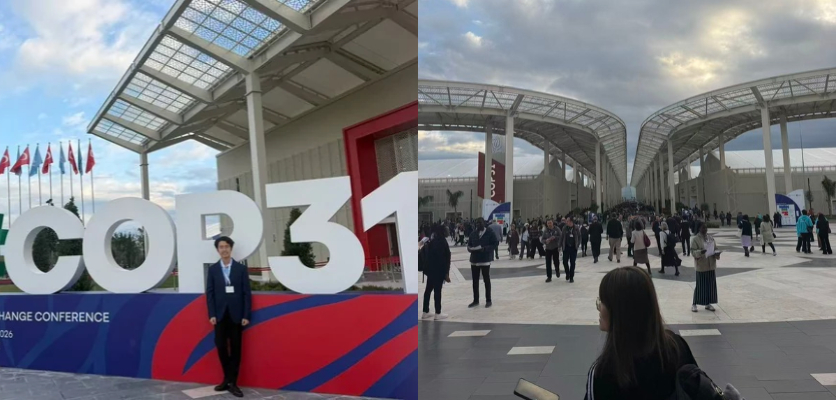
Stopping for a photo in front of the conference of parties sign (left); a crowd gathered beyond the entrance to the conference (right)
My research focuses on the role of the UN in the global carbon market. The carbon market trades carbon credits, a certification of carbon offsets. For instance, it may be very difficult for an airline to reduce its emissions. Thus, they may instead purchase carbon credits from an NGO that plants trees (or protects forests). The NGO receives financing, while the airline offsets its emissions. However, carbon credits suffer major issues with rigor and the accounting details (potential double counting). The UN has long played a central role in regulating the international carbon market, particularly with Article 6 of the Paris Climate Agreement. My research will dive deeper into the effectiveness and shortcomings of Article 6 and of the global carbon market, and where to move forward.
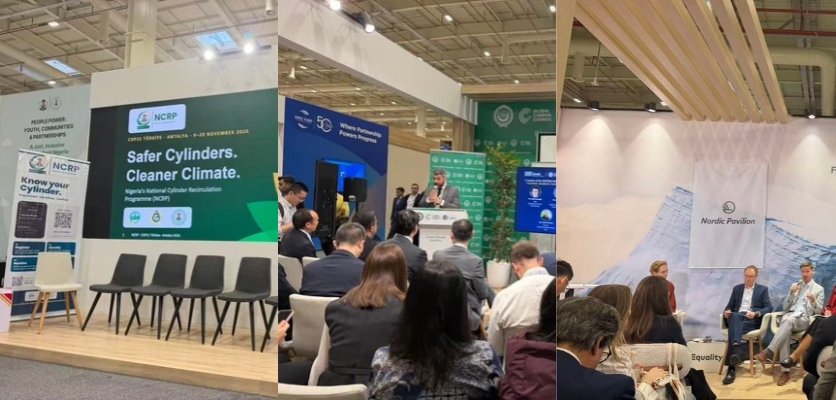
From left to right: the Nigeria Pavilion, the Arab Climate Pavilion, and the Nordic Pavilion
Today is a packed day with many events on carbon credits. I started at the Nigeria Pavilion where they launched the Nigeria National Cylinder Recirculation Program (NCRP), where they created a national registry to track gas cylinders to reduce gas leakage and support clean cooking transition. One of their explicit goals of launching it at COP is to attract carbon market participants to monetize the program to help finance it.
Next, I went to the Arab Climate Pavilion, where the Global Carbon Council, one of the main carbon credit certifiers, launched the Global Carbon Market Network to help coordinate the disparate regulations on carbon markets around the world. I then visited the Singapore pavilion and the International Emission Trading Association (IETA) pavilion for two spirited panels on the regulations of carbon markets from an investor’s perspective, where they describe the tension between the need for a rigorous market that ensures the integrity of the credit, but also ease in administrative tasks that allows for minimum friction in carbon market transactions. My last carbon credit-related panel was at the Nordic pavilion, where the panelists introduced a more radical idea yet: nature credit, where a buyer can pay for the improvement of biodiversity/habitat in an area.
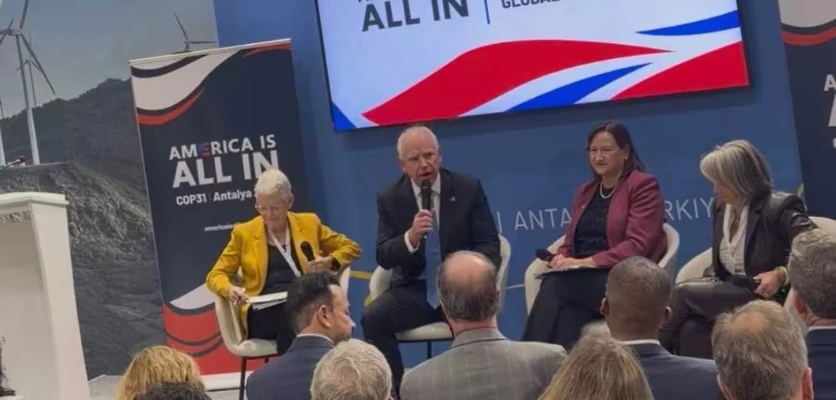
From left to right: former EPA Administrator Gina McCarthy, Minnesota Governor Tim Walz, Palo Alto Mayor Vicki Veeker, and New Mexico Governor Michelle Lujan Grisham
After walking out of the Nordic Pavilion, I stumbled into the All In Pavilion. I initially did not know what was going on, but only to see that the entire pavilion was packed to a point where I couldn’t even see the speaker. It took me a lot of effort to simply make my way into a spot with some visibility: behind a wooden wall structure with gaps between stands. There, I finally saw who drew the crowd: Tim Walz, Minnesota governor and former vice presidential candidate. For the next hour and a half, I made myself comfortable behind the wooden wall, where I, for the first time, saw a long list of faces that I only saw on the news: Gavin Newsom, governor of California; Gina McCarthy, former White House climate advisor and administrator of the Environmental Protection Agency (EPA); and Michelle Lujan Grisham, governor of New Mexico.
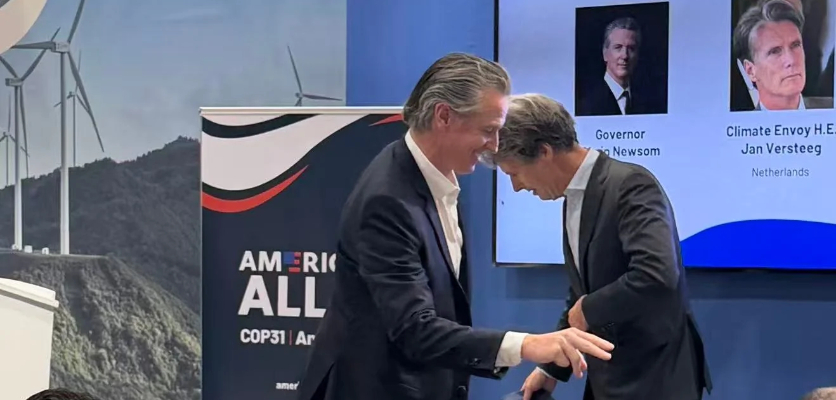
California Governor Newsom greeting Netherlands Climate Envoy Jan Versteeg
This event tied in with the recent New York Times article covering the conference of parties, which lamented the lack of clear climate leadership after the absence of the US. The event tries to challenge that. In it, Governor Newsom and Governor Walz emphasize the case that, even though the federal government is absent, America still shows up at a state and local level. Standing at the back of the session with a couple of students from Midwestern Universities (University of Chicago, Washington University in St. Louis, and Macalester College), I couldn’t help but feel that one of the impacts of having college delegations over is to show the presence of US institutions. It sends the message that despite the federal government’s failure to address climate change, universities like Northwestern still stand with the world against the climate crisis.
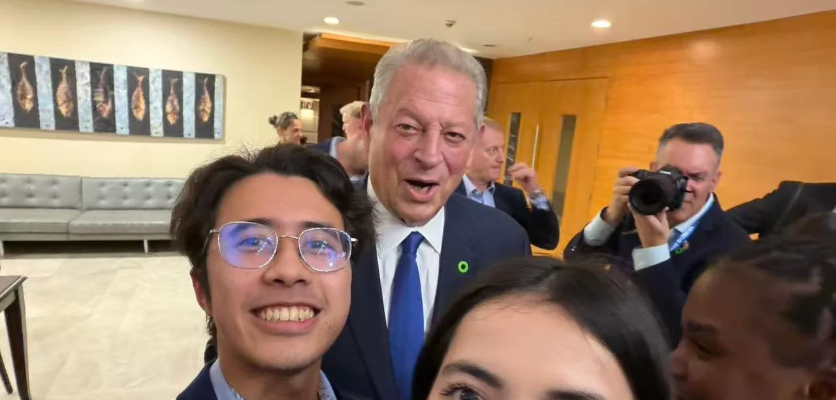
A selfie with former Vice President Al Gore
My final event of the day was spent outside the COP venue, where I went to a special event hosted by the Climate Reality Project, which featured a conversation with former vice president and Nobel Prize-winner Al Gore. This session is very special for me personally, as Al Gore has been one of my biggest inspirations that got me interested in environmentalism and climate change. At the end of the session, I was ecstatic at the opportunity to meet him in person.
There are common criticisms of the COP for being ineffective and excessive. It is easy to see the irony of flying tens of thousands of people every year for a climate conference. Through many of these criticisms stands, COP31 made me feel that the value of uniting people together in dialogues, in community, and in hope justify such costs.