Reflections from Northwestern University's COP31 Delegation: Day 3
 For a sixth year, a delegation of Northwestern University students and faculty supported by the Roberta Buffett Institute is among more than 92,000 researchers, policymakers, industry leaders, and activists at the world’s largest annual international treaty negotiations and climate summit, the 31st Conference of Parties (COP31) to the United Nations Framework Convention on Climate Change (UNFCCC), held this year in Antalya, Turkey. Each day, a different Northwestern delegate is blogging about their experiences and reflections. Day 3 features Adiv Sugoto, a fourth-year undergraduate majoring in political science and international studies.
Each morning of COP31, we left for the venue earlier than the day before.
Eight o’clock on the first day, seven-thirty the second, and 5:45 this morning on my third and final day of access in the Blue Zone. The WhatsApp Community for research and university observers urged us to beat a seven o’clock closure for the heads of state arriving for the Leaders’ Summit, so we boarded the tram from Muratpaşa in complete darkness only to find the entrance queue already spilling onto the main road. In the end, however, the early closure never materialized.
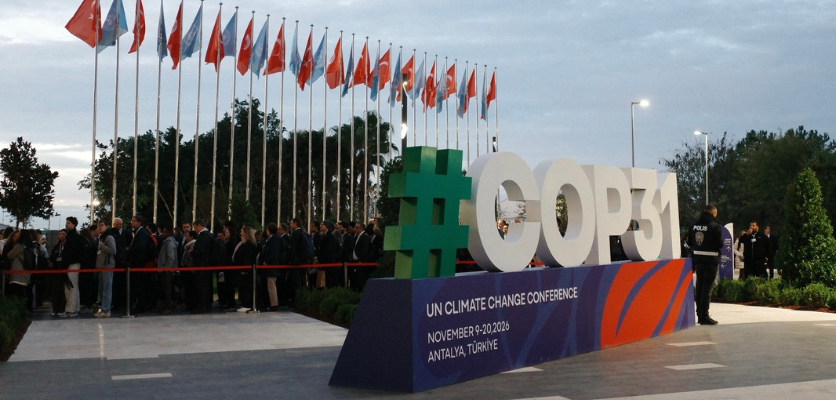
Delegates and observers queue at the venue entrance at 6:45 a.m. on the first day of the Antalya Leaders’ Summit at COP31
Carbon now crosses borders through two systems. While the selling country authorizes which reductions another country may count under one, the European Union through its Carbon Border Adjustment Mechanism (CBAM) decides which foreign carbon prices count under the other. My research in Antalya follows how emerging economies such as Brazil and Indonesia court buyers through carbon-credit trading yet contest, or stay silent on, Europe’s border charge on carbon, and how that balance shifts across the spaces of COP31.
My day began in a coffee line outside the Brazilian pavilion, which I joined for a conversation rather than the coffee itself. Instead, I took one of the free Turkish diet sodas on offer across the Blue Zone, though others seemed to frown upon the choice. In line, a member of the Brazilian delegation walked me through how Brazil prepares exporters for CBAM while pressing Europe for clearer rules. Despite bluntly referring to the mechanism as a trade barrier, he highlighted the importance of access to the European market and of mutual cooperation with the Global North.
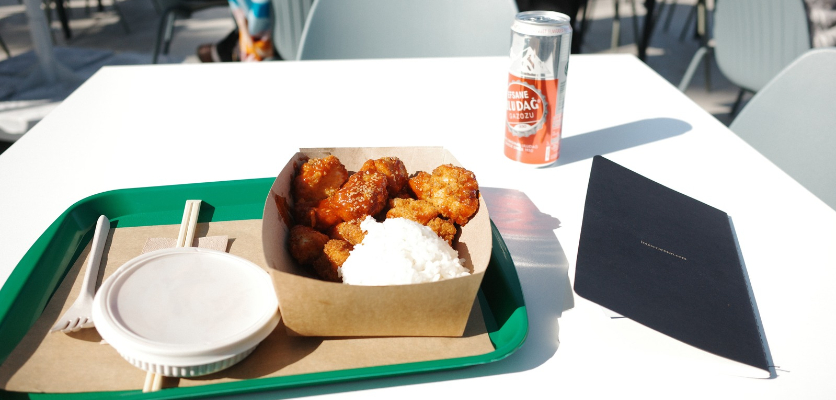
Early lunch and another Turkish soda
From there, I crossed the venue to the International Emissions Trading Association (IETA) Business Hub where I spent much of the day. Shortly before a panel session on implementing Article 6, I managed to sneak in a quick conversation with a second Brazilian delegate. He positioned CBAM within a wider global web of different requirements and certifications and wondered how much such barriers actually do to combat climate change. Once the session started, Brazil’s National Secretary for Climate Change presented the country as one of the world’s future “giants and suppliers” of carbon credits.
The closing line of that session from the Vice President of Sylvera really stuck with me: “Article 6 is 11 years old. It should be in secondary school, yet it has barely graduated kindergarten."
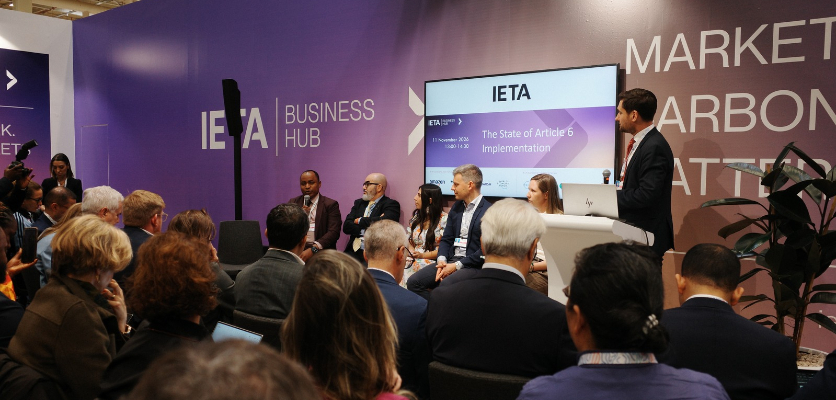
"The State of Article 6 Implementation" at the IETA Business Hub Pavilion
Most of my afternoon broke into short fragments. I would catch opening remarks at one panel and Q&As in another. Cutting across the Russian Federation pavilion, German pavilion, IETA Business Hub again, and finally Special Event Room 1, I chased how both the Global North and South framed and justified their positions on CBAM. Though, ending at a high-level ministerial session on the cross-border effects of climate policy felt fulfilling as it placed both sides of my question in a single room. The EU and United Kingdom defended their border mechanisms, while Türkiye and the Philippines asked that such measures respect national circumstances and become “mutually recognized."
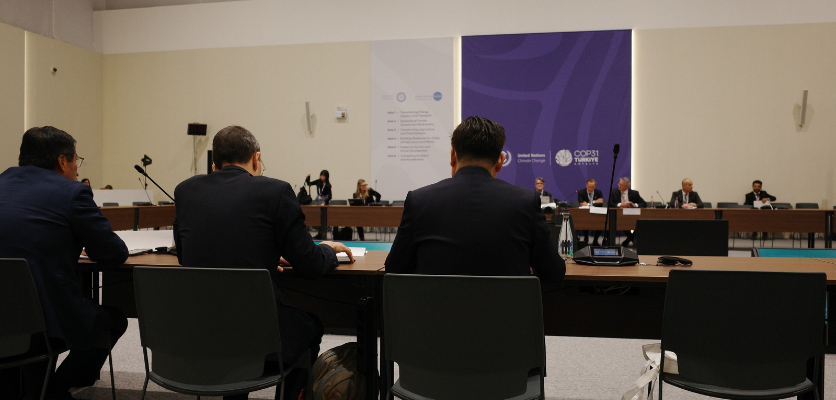
"Cross-border Effects of Climate Policy: Building the Evidence for Stronger International Co-operation" in Special Event Room 1
As I moved, exhausted, through queues, pavilions, and panels, my experience today convinced me that the value of carbon markets lives in rhetoric, attitudes, and audience as much as in rules and prices.