
Reflections from Northwestern University's COP31 Delegation: Day 2
 For a sixth year, a delegation of Northwestern University students and faculty supported by the Roberta Buffett Institute is among more than 92,000 researchers, policymakers, industry leaders, and activists at the world’s largest annual international treaty negotiations and climate summit, the 31st Conference of Parties (COP31) to the United Nations Framework Convention on Climate Change (UNFCCC), held this year in Antalya, Turkey. Each day, a different Northwestern delegate is blogging about their experiences and reflections. Day 2 features Akshita Poddar, a second-year undergraduate majoring in economics and political science. At COP31, she is studying in how AI is entering climate conversations for the first time as a topic of discussion, and what its growing role might mean for climate action.
Day two of COP31 started with a lesson in patience.
I arrived later than planned after getting stuck in the terrible transportation that seemed to be frustrating almost everyone I spoke to. It was a slightly ironic way to begin a conference focused on solving some of the world’s biggest coordination problems. Outside the venue, I was greeted by a protest, and inside, by something considerably more cheerful: Sustain-A-Claus, a climate-themed Santa Claus. Within a few minutes, I had seen two very different sides of COP.
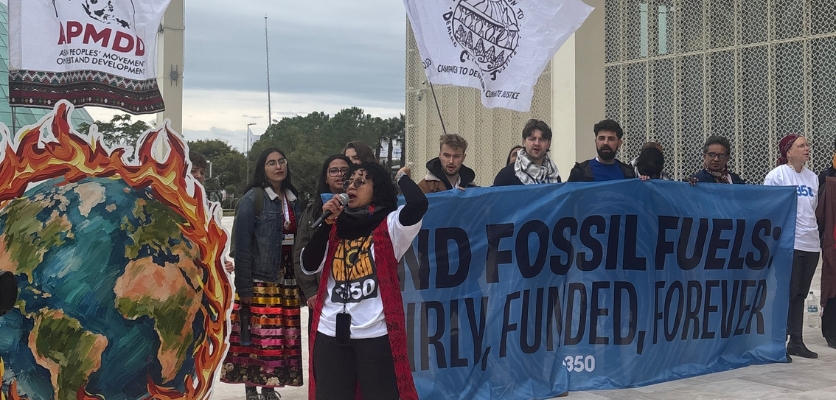
Protest at the COP31 Blue Zone entrance
One of the most exciting parts of the day was receiving an observer placard for the 65th session of the Subsidiary Body for Scientific and Technological Advice (SBSTA 65) on technology development and transfer. The session itself was delayed, but the extra time turned out to be an unexpected opportunity. Before the meeting began, I had the chance to speak informally with several delegates about the agendas they were bringing into the negotiations and the priorities they hoped to advance. These conversations gave me a glimpse into the thinking behind the formal proceedings. It was interesting to hear how different representatives approached the same issues, especially when it came to making climate technologies more accessible to developing countries.
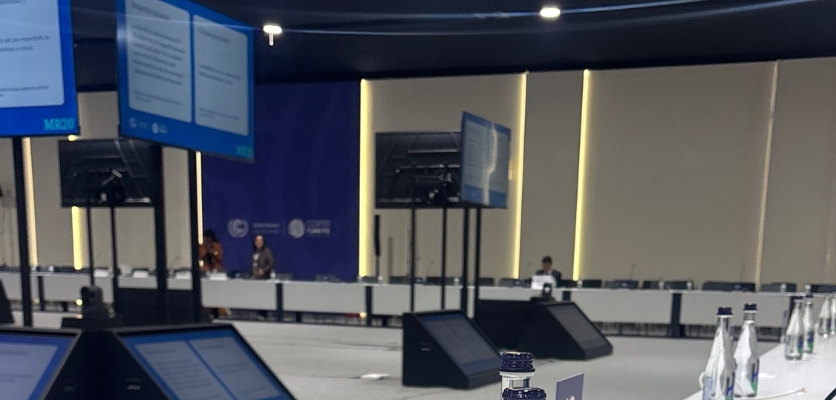
Negotiation session on climate technology transfer and development
Outside the negotiation rooms, I spent a large part of today wandering through the country pavilions. These quickly became some of my favourite spaces at the conference. Besides the displays and presentations, they offered opportunities to meet people working on different aspects of climate policy, hear what their countries were focusing on, and strike up conversations that would probably never happen otherwise.
I was surprised to see how frequently AI and new technologies came up in the side events I attended. Some discussions focused on using AI for climate prediction, designing more resilient infrastructure and improving energy systems. Others turned the question around: as AI becomes more widespread, how do we make the technology itself more sustainable? Data centres were a recurring topic, with conversations about their growing energy demands and the need to make them more efficient. I found this helpful for my research as it brought a different perspective to the usual conversations on how AI facilitates climate solutions. In one of the panel discussions, led by data centre companies, representatives spoke about the growing demand for data centre infrastructure and the challenges of making it more energy efficient. It was refreshing hearing the companies themselves acknowledge the environmental footprint of AI and explain how they are thinking about reducing it.
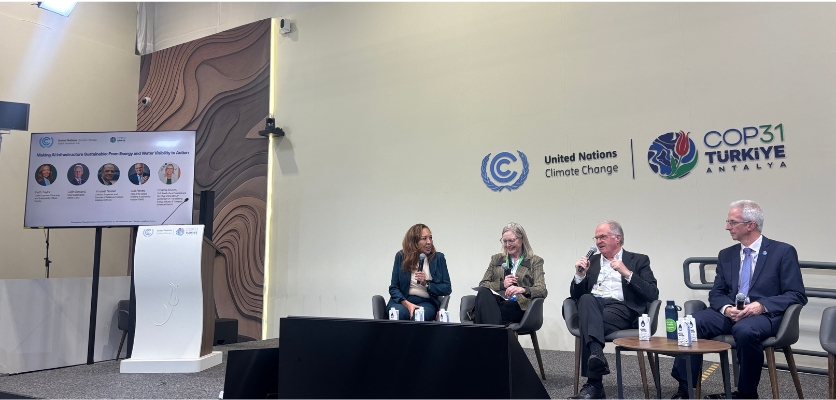
Session on making AI infrastructure sustainable, led by representatives from data centre companies
On reflecting on the day, I think that perhaps the hardest part of addressing climate change is not a lack of ideas or even technology. It is figuring out how to bring people, resources, and institutions together to make those ideas work. And judging by the morning's traffic, coordination is not always easy even when everyone is trying to get to the same place. Today, I definitely didn't manage to see or attend everything I wanted to, but I feel that is also part of the experience. I left tired, with a very full notebook and plenty to think about, already looking forward to what the next day would bring.