
Reflections from Northwestern University's COP31 Delegation: Day 12
 For a sixth year, a delegation of Northwestern University students and faculty supported by the Roberta Buffett Institute is among more than 92,000 researchers, policymakers, industry leaders, and activists at the world’s largest annual international treaty negotiations and climate summit, the 31st Conference of Parties (COP31) to the United Nations Framework Convention on Climate Change (UNFCCC), held this year in Antalya, Turkey. Each day, a different Northwestern delegate is blogging about their experiences and reflections. Day 12 features Lana Alnajm, a third-year undergraduate majoring in social policy and data science.
Walking into COP31, a volunteer from the ECO newsletter handed me a flyer. Printed across it, in large letters, was one word: SHAME.
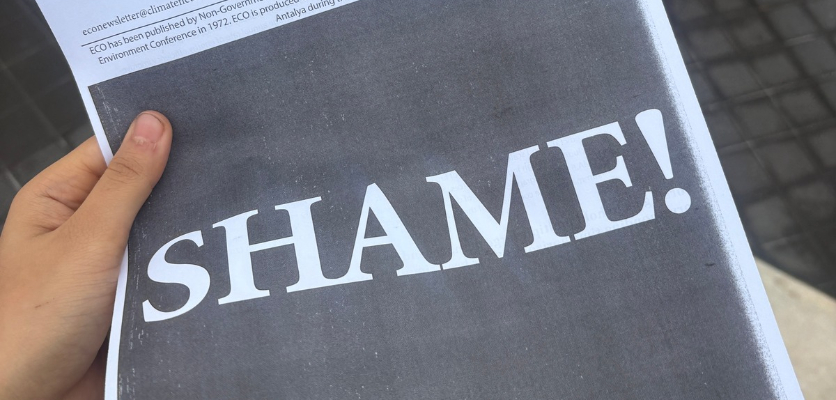
The ECO Newsletter is a daily printed flyer or bulletin distributed at the venue. It is the official civil society publication produced by Climate Action Network (CAN).
It was an incredibly sobering way to begin the day. Inside the conference, delegates were negotiating the language of climate action while civil society organizations gathered outside the negotiating rooms to ask what exactly that language would amount to.
As the morning unfolded across back-to-back meetings, I noticed the quiet ache of disappointment over the new draft cover lingered in every conversation. An earlier version, released by the COP31 presidency, had included language on phasing out or transitioning away from fossil fuels. But by Thursday, those references failed to make it in the next draft text. For a conference repeatedly described and framed as an implementation COP, the possibility that it would conclude without even naming the transition away from fossil fuels felt extremely incongruous.
Speaking alongside representatives of vulnerable island nations calling for a legally binding international treaty to curb fossil fuel production, Panama’s environment minister, Juan Carlos Navarro, warned against allowing the final agreement to dilute the issue. “Climate change is a risk to our very survival as a nation,” he said. “For Pacific nations, this isn’t another agenda item. This isn’t a game for us.” At an earlier press conference I attended with the minister, his position on the final text was unequivocal: “Panama will not support any language nor any resolution that omits this vital principle.” and will “not lend its name [to] complacent or ineffective language.”
At the Research and Independent Non-Governmental Organizations (RINGO) meeting, the discussion offered one possible way of thinking about what happens beyond the COP process. Participants spoke about the second International Conference on the Just Transition Away from Fossil Fuels, planned for Tuvalu in July 2027, building on the first gathering in Santa Marta, Colombia. However, this conference is viewed as complementary to COP, rather than an alternative that will radically challenge the existing landscape of climate governance.
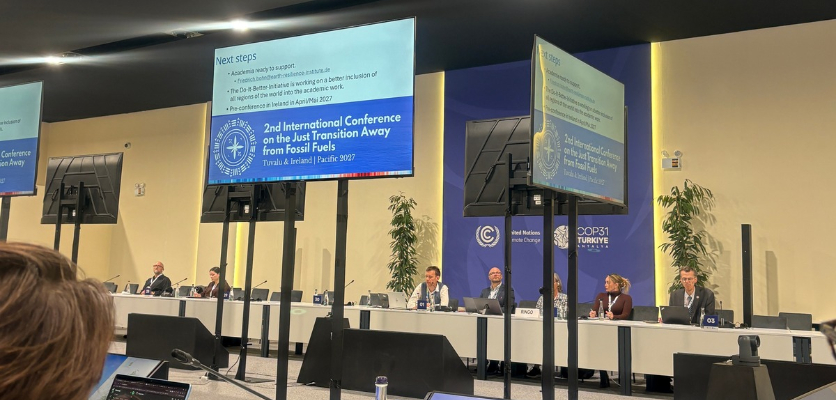
Daily morning RINGO constituency meeting
At a press conference hosted by the Global Campaign to Demand Climate Justice, the frustration was evident. One by one, speakers called out wealthy nations for dodging their climate finance debts while peddling techno-fixes that merely repackage the same extractive systems driving the crisis. Asad Rehman didn’t mince his words, branding COP31 a “backsliding COP,” a stark betrayal of the implementation summit it was meant to be. Beside him, Meena Raman dismissed the proposed cover decision as an “empty shell”: dressed up in grand, ambitious language, yet hollowed out of any real roadmap or meaningful adaptation finance.
When the floor opened for questions, I asked them what real inclusion looks like inside the UNFCCC. Beyond symbolic gestures, how can frontline communities, Indigenous peoples, and civil society actually hold any decision-making power?
They told me: “Nothing less than seats at the table” and an actual role in implementing its work.
Pointing back to COP30, they reminded the room of bold pledges declaring that a just transition is impossible without youth, local communities, Indigenous peoples, and gender equality. A year later, those promises remain unfulfilled on the ground. What truly stuck with me is when they conveyed that participation has been a hollow promise and the very people most affected by climate decisions had no institutional power to truly shape outcomes.
That exchange connected with a broader concern in my research which I have yet to talk about, which examines how climate vulnerable countries and civil society actors use international legal principles to advance claims for climate justice, and the challenges of translating those principles into political and material outcomes. The 2025 International Court of Justice advisory opinion clarified states existing obligations in relation to climate change. Article 9.1 of the Paris Agreement also establishes obligations for developed countries to provide climate finance. But legal recognition has thus far not produced binding commitments for actors responsible at this COP.
At the Climate Action Network (CAN) press conference shortly after, speakers also vehemently rejected a cover decision that, despite its 18 pages, offered little on the priorities they had come to fight for: a just transition mechanism, adaptation finance, and public funding that could reach vulnerable communities. One speaker captured the frustration in a single sentence: “The COP is not dying, but it is being killed!"
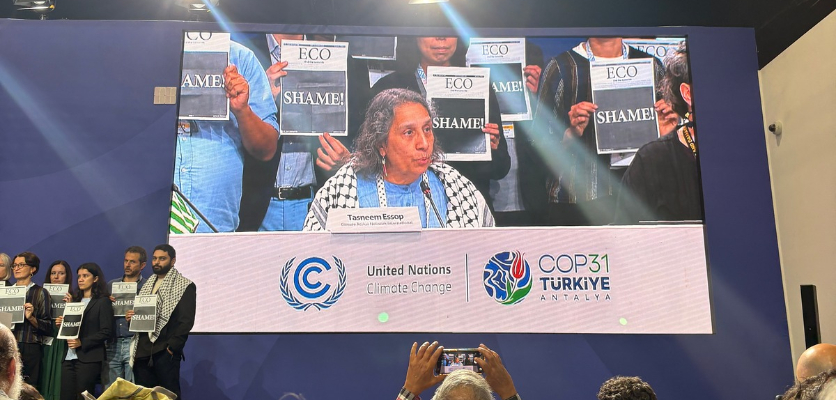
Final CAN press conference with their members carrying the flyers saying SHAME
It was a striking distinction. Strip away the diplomatic performative theater and all the broken promises, and you can discern why everyone keeps returning. COP is one of the last remaining rooms where developing countries and civil society can drag wealthy nations into the light of accountability. Too often in global politics, vulnerable nations are treated like items on the table and bargaining chips to be traded away. Here, however imperfectly, they can potentially pull a chair around it and actively refuse to let their futures be decided behind closed doors. When a journalist asked whether delegates should walk out if there was an unfavorable outcome, the answer the panelists gave were no to my surprise. Developing nations should stay, push, and force the room to reckon with their presence and their asks.
At the Palestinian Pavilion, I encountered another meaningful dimension of climate justice in a session titled “How Israel Weaponizes Conservation to Erase Palestinian Ties to the Land,” Palestinian-American photographer and filmmaker Yazan Aboushi discussed how conservation can be used to legitimize displacement. Aboushi pointed to depopulated Palestinian villages repurposed as national parks, where official signage rewrites the 1948 Nakba, a catastrophe of mass displacement, into a sanitized footnote about villages “destroyed in the war of independence.” Alongside the rewriting of the landscape comes the policing of daily life where foraging of native plants central to Palestinian food traditions and cultural memory have been historically criminalized to colonize food systems and eradicate cultural memory.
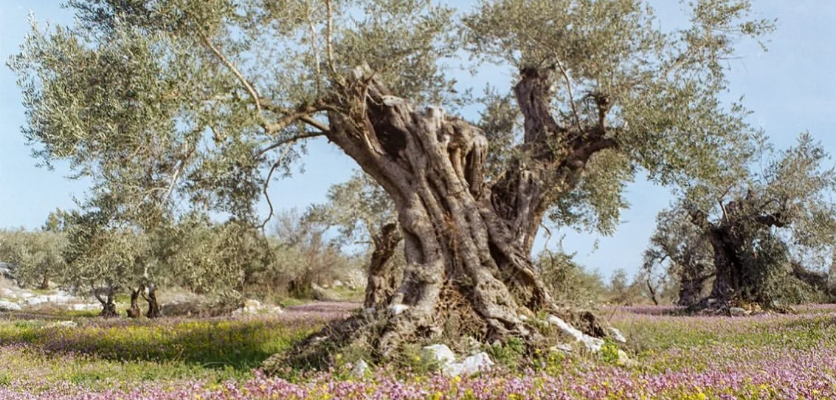
A photograph by Yazan Aboushi: Spring in Palestine among the rumiyah olive trees
It was a powerful challenge to the myth of apolitical environmentalism. Many “green” and sustainable practices are often treated as an unquestionable good, yet they can easily be wielded to curate nature while editing out the people whose relationship with that soil predates the institutions claiming to save it. If climate justice truly means anything at all, it cannot be divorced from questions of land and exactly whose knowledge is legitimized in the name of protecting the earth. Yazan is also amazing! Arab Americans unite at COP!
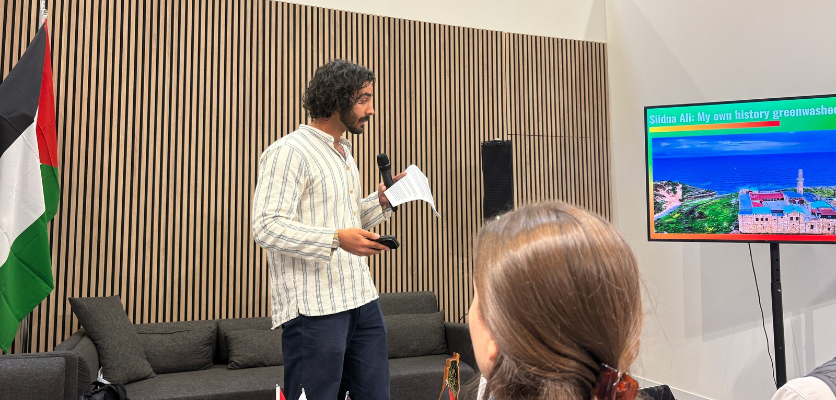
Yazan Aboushi talking about his own village he was displaced from which has become greenwashed
This realization during my time here studying justice at COP, that climate justice cannot be separated from historical responsibility and power, was impossible to shake and followed me straight into the closing plenary. As the speeches blurred together, one word from a protest sheet kept flashing in my head: SHAME.
It sums up the impossible tightrope that is COP. Yes, it remains one of the few spaces where developing nations and civil society can call out wealthy states. Yet the system currently is built to absorb all of this frustration and pressure and neutralize it, watering down genuine survival-related demands through consensus rules, procedural bottlenecks, corporate lobbyists in the hallways, and poetic and non-binding text that gives us a whole lot of nothing.
More broadly, COP31 has left me wrestling with the legitimacy, and the clear limitations, of the UNFCCC framework that is being echoed throughout the halls of each meeting room. Is this process still capable of delivering what communities, developing countries, and civil society are fighting for, or are we watching a shift toward international courts, regional legal rulings, political mobilization, and grassroots movements that refuse to wait for lukewarm consensus?
Many of us left this COP noticing how far apart a raised voice and a final decision still are. The front page read SHAME, loud enough to rattle the glass. Yet we are all left looking at closed doors, wondering what happens in the negotiating room once they read that one word many are echoing and whether it will change anything.
On a lighter note though! Here are some other moments from the day!
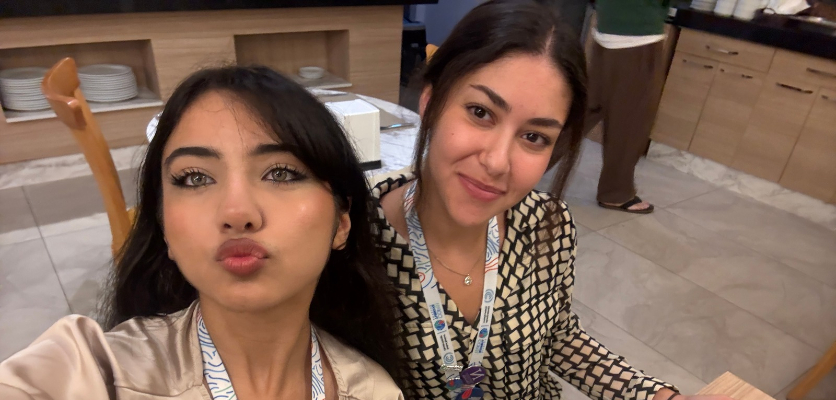
Last 7 a.m. breakfast! We are sleeping in tomorrow!
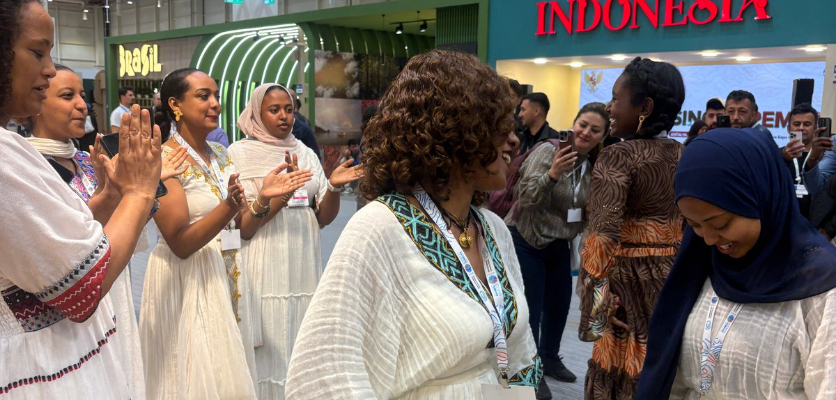
Ethiopians dancing! They are hosting next year’s COP