
The Aftermath of Operation Absolute Resolve: Northwestern Faculty Discuss US-Latin America Relations
What does the recent US military operation in Venezuela mean for the future of US-Latin American relations? How does the capture of Venezuelan president Nicolás Maduro and his wife, Cilia Flores, impact the political stability of Venezuela and the future of international law?
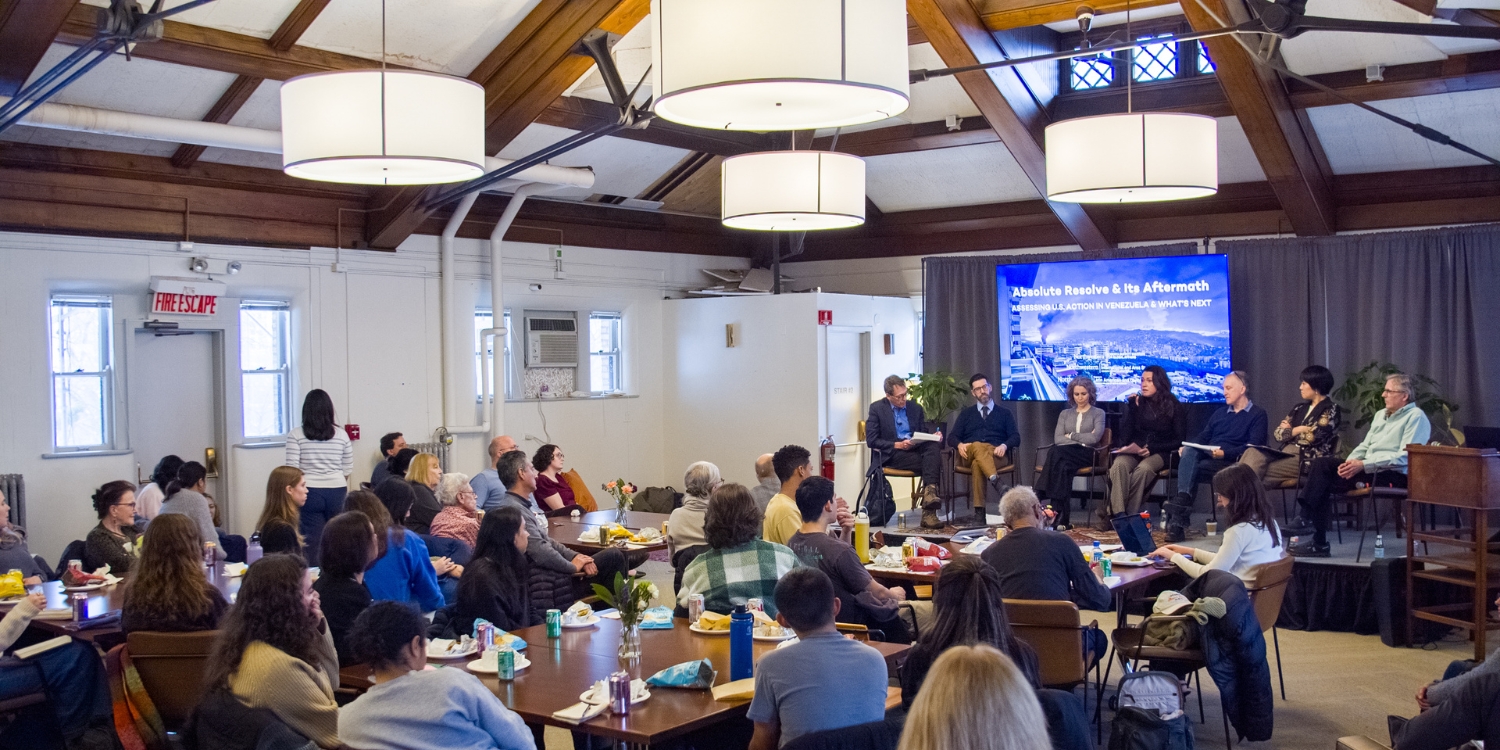
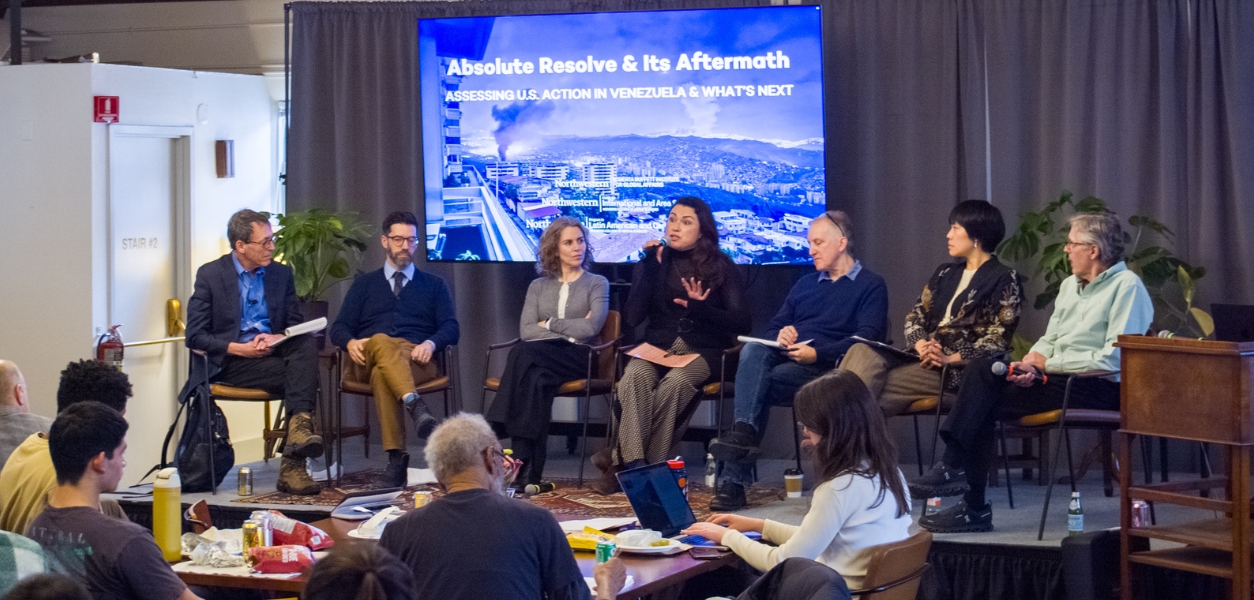
To answer these questions, the Roberta Buffett Institute for Global Affairs, the Weinberg College Center for International & Area Studies, and the Latin American & Caribbean Studies Program recently brought together faculty experts in political science, history, and sociology.
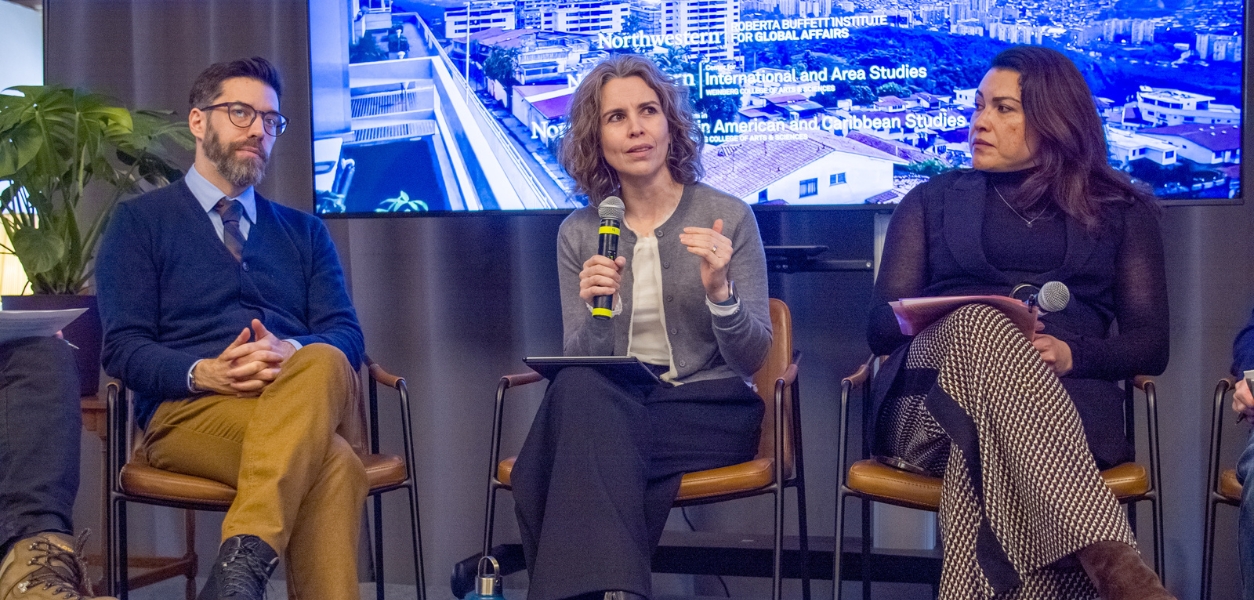
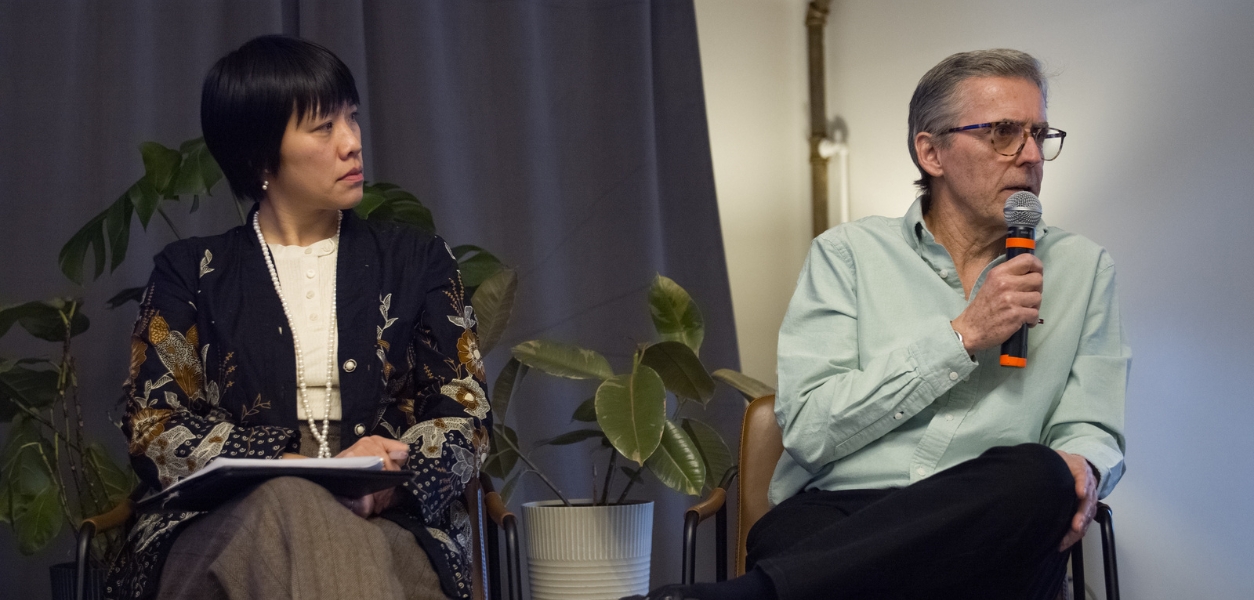
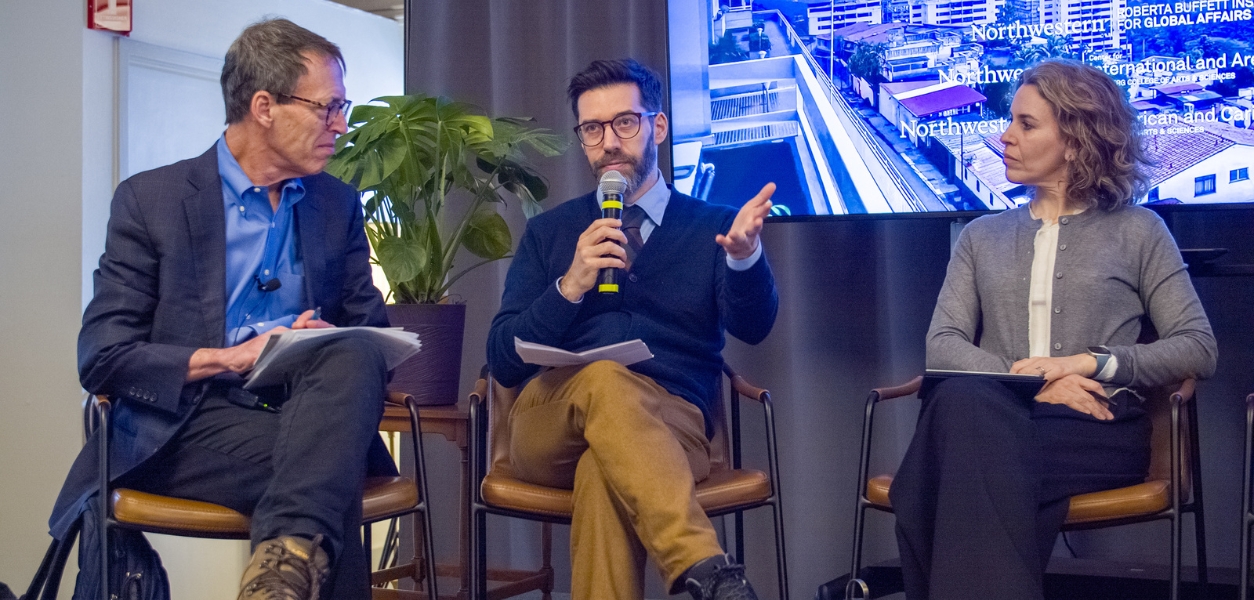
Panelists included Ana Arjona, Associate Professor of Political Science; Lina Britto, Associate Professor of History and Buffett Faculty Fellow; Edward Gibson, Kenneth Burgess Professor of Political Science; Daniel Immerwahr, Bergen Evans Professor in the Humanities and Charles Deering McCormick Professor of Teaching Excellence; James Mahoney, Gordon Fulcher Professor of Decision-Making and Professor of Political Science and Sociology; and Katrina Quisumbing King, Assistant Professor of Sociology. The panel was moderated by Peter Slevin, Professor of Journalism and contributing writer to The New Yorker.
Does Operation Absolute Resolve signify a shift in the Trump administration's approach to foreign policy?
“Usually US military action has been wrapped in an explanation of why this is consistent with the norms that the United States seeks to uphold. But Trump seems completely uninterested in making that case. In his press conference, he started with the legal case against Maduro, which was a thin pretext, and then immediately, just unbidden, started talking about oil. You can regard Trump as offering a kind of welcome candor. But you could also see this candor as an attack on norms—no longer even paying lip service to principles.
Trump's foreign policy is also interestingly narrower than liberal internationalism. He thinks hemispherically. He thinks in terms of particular places. He doesn't seem to have a kind of system in mind. But Trump's understanding of what the United States might do to pursue its narrow interests is also much broader.”
—Daniel Immerwahr, Bergen Evans Professor in the Humanities and Charles Deering McCormick Professor of Teaching Excellence
“The most problematic consequence of this operation for Latin America and the world is the explicit abandonment of international norms even in an aspirational sense—norms like respecting the sovereignty of other countries and defending the sanctity of human rights. Homeland Security Advisor Stephen Miller dismissed what he called “international niceties” and some politicians are openly musing about returning to a view of politics as raw power, where strong countries believe they have the license to do whatever they want.
These actions—and the way they were justified—can change how powerful countries calculate risks, costs, and obstacles when they think of annexing territories, intervening in other countries, or committing human rights abuses. It is a very clear signal, particularly to Latin America, that this is a very unsafe environment, without even the pretense of any commitment to international law, norms, or human rights. Of course, enforcement of these norms has failed many times, but when we share these norms as aspirations, they shape the rhetoric and behavior of leaders. Now, we are in the midst of an unpredictable brave new world.”
—Ana Arjona, Associate Professor of Political Science and former Director of the Center for the Study of Security & Drugs at Los Andes University
How might this new approach reshape the political scene in Venezuela?
“The general view of people who support Operation Absolute Resolve is that the steps taken in this intervention make sense: remove Maduro, stabilize the nation of Venezuela according to US interests, and in the long run, extract the natural resources and fulfill the tenets of the 'Trump Corollary' to the Monroe Doctrine. The Trump administration seems to think that Operation Absolute Resolve will remove China from the Venezuelan oil industry, restructuring it with the US once again as its main customer without regime change.... What we've done is inject tremendous volatility into the complex system of alliances that held the authoritarian Maduro regime together, as well as the relationship between government and opposition.”
—Edward Gibson, Kenneth Burgess Professor of Political Science and co-founder of Northwestern's Comparative Historical Social Science Program
“The key ingredients for a future revolution in Venezuela might now be emerging through denial of sovereignty, foreign meddling in Venezuelan policy, and the US taking on a guardian role, resulting in paternalism, tutelage, economic imperialism, dependency, and possibly occupation forces. Those were the very ingredients that fueled previous revolutions in Central America. They could do the same in Venezuela.”
—James Mahoney, Gordon Fulcher Professor in Decision-Making, Professor of Sociology, and Professor of Political Science
The Trump administration’s justification for Operation Absolute Resolve was drug trafficking. How has this rhetoric legitimized the intervention to the public, and what does data show about Venezuela’s role in the US drug crisis?
“According to the first indictment against Maduro and his collaborators produced during Trump’s first administration in 2020, members of the Maduro administration ‘participated in a corrupt and violent narco-terrorism conspiracy between the Venezuelan Cartel de Los Soles and the Revolutionary Armed Forces of Colombia, FARC, that prioritized using cocaine as a weapon against America and imported as much cocaine as possible into the United States.’ The use of the ‘narco’ label allowed the Trump administration to desensitize the American public to the upcoming violations of international law that trample on the sovereignty of Venezuela. Since this position, the sovereignty of Venezuela was criminalized, as synonymous with protecting criminal activity. Because Operation Absolute Resolve was publicly presented in the US as a law enforcement operation, the Trump administration claimed that there was no violation of international law or sovereignty. It was a surgical operation to capture an indicted criminal.”
—Lina Britto, Associate Professor of History, Buffett Faculty Fellow, and journalist
“The epidemic crisis with drugs in the US has been linked, of course, to fentanyl. There has never been a report or data that suggests that fentanyl comes from Venezuela or from South America in general. And while cocaine is a different story—Venezuela is a corridor through which cocaine is trafficked to Europe—most of the cocaine that comes to the US is trafficked not through Venezuela or South America but through other regions. Venezuela does not grow the coca plant. This data does not justify Maduro’s capture. There is no possible logic whereby attacking Venezuela or removing Maduro or the entire regime would change the inflow of cocaine into the US.”
What are other possible causes for this intervention?
“The roots of US foreign policy in Latin America are often thought about in terms of three sets of interests: national security interests, economic interests, and domestic politics. One could certainly find evidence that Operation Absolute Resolve was motivated by these interests, especially national security and economic interests. The more important cause was cognitive in nature, however: it's the conviction that hostile, unfriendly governments in Latin America are unacceptable, and removing them is appropriate and just. The immediate goal was to replace a very unfriendly government with a less unfriendly government.
Underpinning this conviction is a set of assumptions about Latin American subordination and inferiority, rooted in beliefs that Latin American countries are indebted to the US for keeping Europe out of the region, for spreading successful capitalism and economic opportunities, and for providing a model of a successful country. The most important cause of Operation Absolute Resolve was the re-emergence of this US administration’s ideas about US superiority and dominance in the Western Hemisphere, which had seemed to be a thing of the past.”
How does Operation Absolute Resolve fit into the longer history of the War on Drugs?
“The War on Drugs is a toolkit of strategies, resources, and technologies to administer state violence. During moments of crisis, it is usually implemented in regions and against people of the political geography of a country where the authority and legitimacy of the state has been called into question. As a toolkit for the administration of state violence is flexible, malleable, and worked well to prepare the soil for regime change in Venezuela. In this sense, the War on Drugs has never been the failure we have come to think of it as. It did fail to reduce the flow of drugs to the largest market in the US, but as a toolkit for the administration of state violence, it has been a total success. Operation Absolute Resolve is proof of that success.”
How does the United States’ approach today compare to past eras of American foreign intervention and expansion? What has changed in the way US power is exercised and justified on the global stage?
“As a historian, it’s a bit unclear what to make of the current unfurling chaos. There are different names for US hegemony, but at a basic level it is the post-1945 notion that the role of the United States is to police or superintend global affairs. Defenders of this idea call it ‘the liberal international order.’ They not only think it's a good thing, but ultimately regard the United States as an umpire, calling the fair and foul, and backing that up with force to guarantee fair play. They point out that a game without an umpire would be anarchy, and that having a different umpire, like Russia or China, would be a catastrophe of a different kind. I am a critic of hegemony, and critics like myself are less likely to call it umpire than to call it empire.”
“Debates over foreign interventionism have shaped US imperialism and intervention abroad throughout US history. Although the US has always been an empire state, imperial state formations change. US capitalist, extractive, and military interests are laid bare without this former veneer of a civilizing, humanitarian, or paternalistic democracy-building mission. In the late 1800s and early 1900s, territorial conquest was understood as a way to gain state power. And then there was World War II: a war of empires and a race war. It was a war in which the broad critiques of explicit, hierarchical, formal colonial rule grew, and the critiques against racism grew. At this time, formal empire fell out of favor on the world stage. In the 20th century, US state actors transformed their interventionist project into an informal one, dressed up not in the language of civilization, but in that of democracy.... Now, in an era without USAID and under the pretense of anti-drugs coupled with anti-terror, we see the capitalist and strategic interests of the United States laid bare.”
—Katrina Quisumbing King, Assistant Professor of Sociology