
Buffett Q&A: Our COP30 Student Delegates on Regime Complexity, Nationalist Narratives, and Scientific Representation

For a fifth year, a delegation of more than a dozen Northwestern University students and faculty attended the 30th Conference of Parties (COP30) to the United Nations Framework Convention on Climate Change (UNFCCC) in Belém, Brazil. The annual climate conference convenes world leaders, policymakers, and researchers to confront urgent environmental crises and drive solutions. As delegates to COP30, students engaged in critical discussions about global climate governance.
Supported by the Roberta Buffett Institute for Global Affairs, Northwestern’s student delegation prepared for COP30 by attending a quarter-long research seminar designed and taught by Iza Ding, Associate Professor of Political Science and former Buffett Faculty Fellow. Through readings, guest lectures, and workshops, students developed original research projects, which they then carried out at the conference by conducting ethnographic studies, qualitative interviews, and direct field research.
 Kevin Wagner
PhD Student, Weinberg College of Arts & Sciences’ Department of Political Science
Kevin Wagner came to COP30 with an interest in understanding how international governance becomes fragmented across overlapping mandates, institutions, and messy lines of authority.
He studies international environmental politics, focusing on cooperation within global governance frameworks. Drawing on the political science framework of regime complexity — the complexity that arises from interactions among a group of international organizations and agreements that all deal with the same issue, working together at times and clashing at others — he examines how overlapping institutions shape power and decision-making in international climate negotiations. “There's a lack of hierarchy within the overlap. You're trying to identify who holds the power despite the fact that technically nobody is supposed to,” he explained.
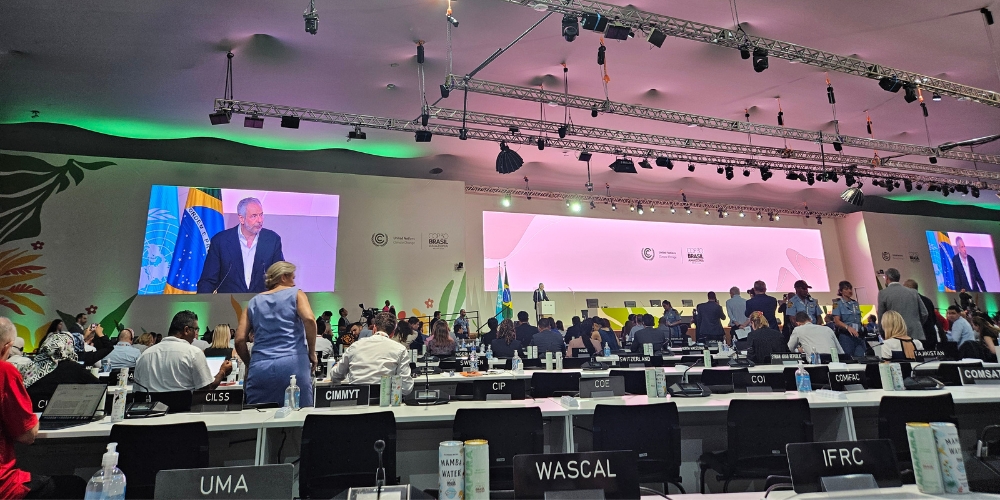
Discussion at COP30. Photo courtesy of Javiera Cabezas Parra.
During COP30, Wagner focused on how cooperation unfolds in practice within international negotiations. He observed that while many actors are committed to advancing climate solutions, negotiations are often slowed by procedural disputes and strategic obstruction. “Whenever you would go to any dialogue, there would always be several parties that clearly did not want to accomplish anything.... These complaints range from real equity concerns to, ‘I'm going to complain about process for tens of minutes at a time and go beyond my time limit just because I actually don't want to find a group solution here.’” He also found that while overlapping governance frameworks exist, they are less visible in practice than expected, as negotiations tend to remain centered on a single institutional structure.
Wagner left COP30 with a more nuanced understanding of international climate negotiations. “I typically work in quantitative data analysis, and that's how I've looked at international negotiations before. I realized there are certain things on the ground that you can't access using that data,” he shared.
 Addison Feldman
Undergraduate; Social Policy, International Studies, and History; School of Education and Social Policy ‘26
At COP30, Addison Feldman was excited for the opportunity to witness not only the negotiations, but also the informal interactions among government delegates, NGOs, the media, and more.
She focused on how nationalism shapes global climate cooperation. Feldman’s interest in climate policy began through early involvement in community-based environmental activism, and her research examines how domestic political dynamics within European Union member states influence their willingness to engage in collective climate action.
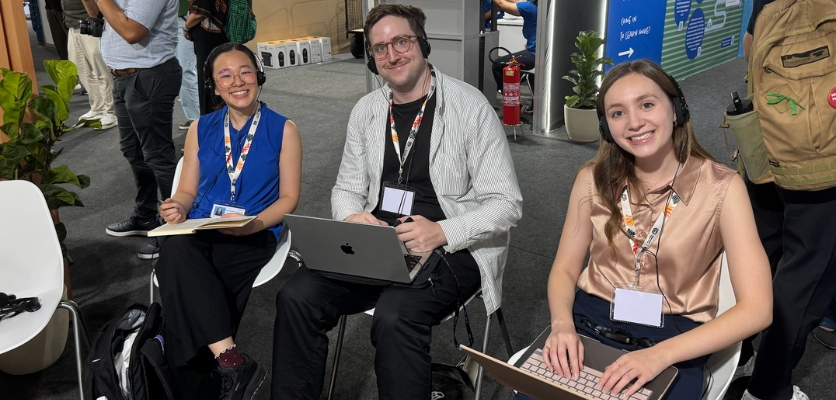
Addison Feldman (right) at COP30. Photo courtesy of Addison Feldman.
During COP30, Feldman analyzed how nationalist narratives appeared in international climate negotiations, highlighting how domestic political priorities shape participation in global climate governance. She observed that even countries positioning themselves as leaders through green nationalism can reframe these narratives to justify limited engagement. “It’s less about the typology of the nationalism that’s being displayed and more about who’s in power and how they’re shaping it. It’s a very important lesson for us to consider who our leaders are and the rhetoric that they're using,” Feldman said. "The opportunity to conduct this research was really incredible and not something that I’d had the opportunity to do in this level of depth at Northwestern before.”
 Javiera Cabezas Parra
PhD Student, McCormick School of Engineering’s Department of Chemical and Biological Engineering
At COP30, Javiera Cabezas Parra hoped to gain insight into which factors, such as geographical proximity, affect participation levels of underrepresented scientists and technical experts from the global south.
She is a scientist with a broader interest in science policy and diplomacy. Her research project explored how scientific knowledge is produced and applied, and she approached COP30 by examining whether hosting the conference in Brazil increased participation from Latin American scientists, drawing on her perspective as a researcher from Chile.
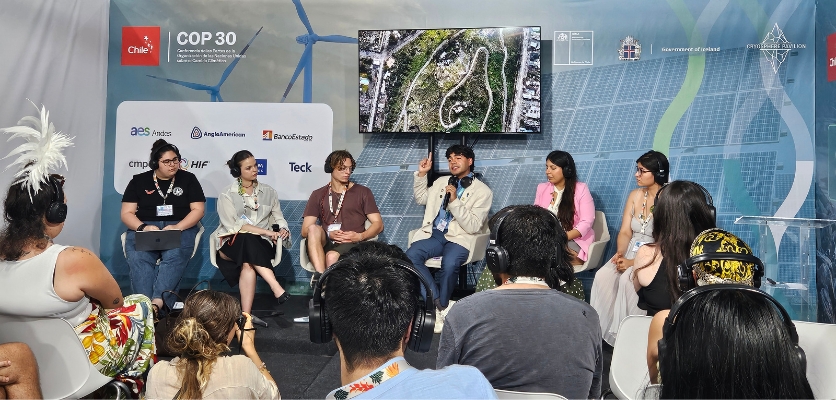
COP30 panel. Photo courtesy of Javiera Cabezas Parra.
During COP30 in Belém, Brazil, she examined the role of scientific expertise in climate negotiations and participated in discussions on higher education and science policy. While many countries emphasized science as a foundation for decision-making, she observed that scientific experts themselves were often underrepresented in these spaces. “There is a heavy focus on science, but unfortunately the actual scientific participation isn’t really there. It revealed a more global issue, that there is a lack of scientific representation from most countries,” Cabezas Parra said. Her research pointed to a broader gap between the production of scientific knowledge and its use in global governance, raising questions about how expertise is communicated and incorporated into policy processes.
Attending COP30 reshaped her understanding of the role of research in global climate governance, particularly how scientific knowledge is ultimately used in decision-making. “There needs to be a change in whether or how academia and politics prioritize including the scientists involved in decision-making rather than having economists or bureaucrats translating their scientific work.”
Northwestern's delegation to COP30, supported by the Roberta Buffett Institute, conducted original research through the a fall-quarter research seminar designed and taught by Iza Ding, Associate Professor of Political Science. Students in the course studied how international climate negotiations work, how different actors shape governance, and how researchers can study these sites while considering the potential for these sites to address climate change. Read more students' reflections from COP30, and learn more about this opportunity supported by the Roberta Buffett Institute >>
Video interviews with Feldman and Cabezas Parra will be published this summer.