
Buffett Q&A: Reflections from Our Inaugural Elliott Scholars
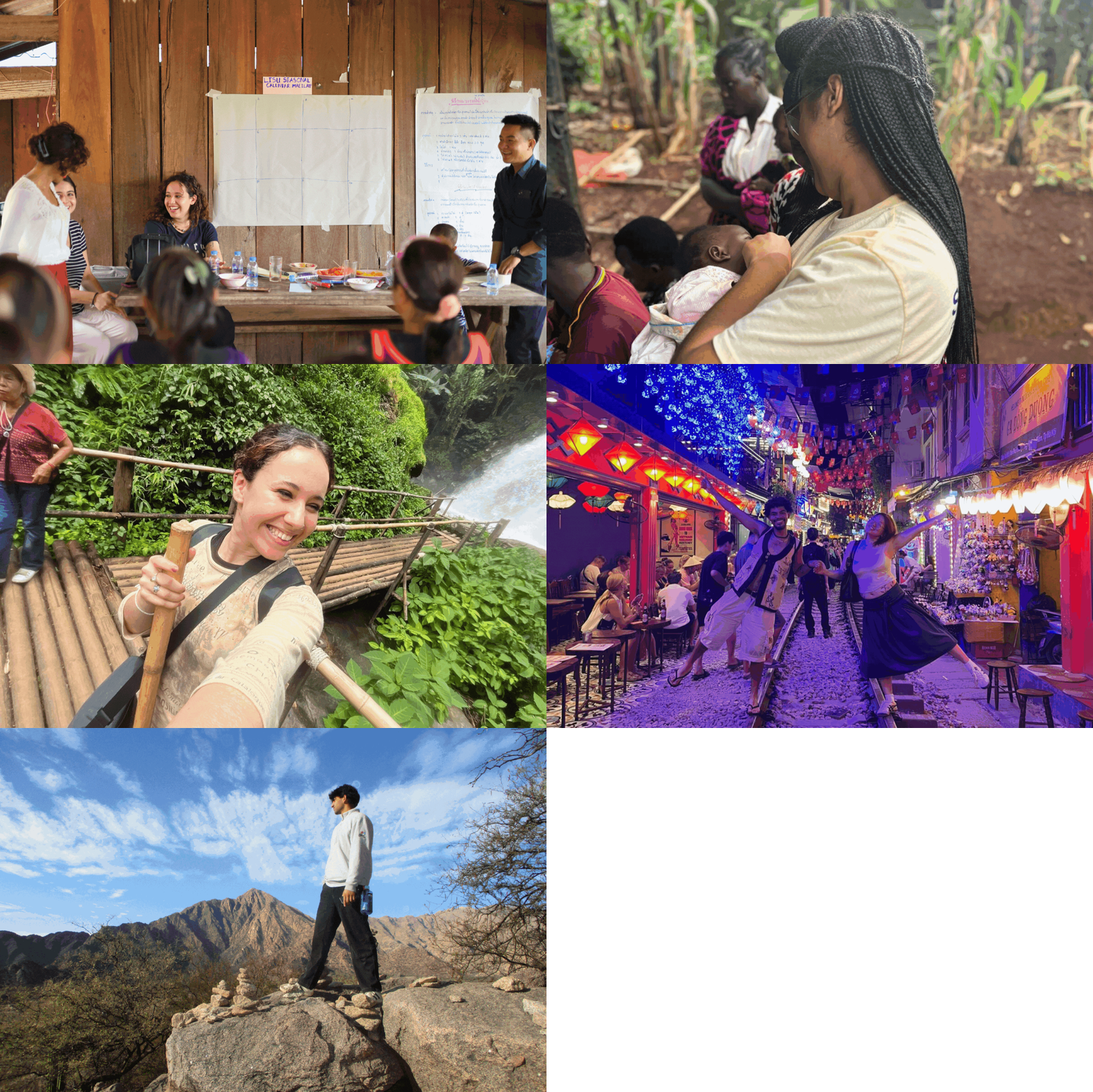
Established in 2024, the Roberta Buffett Institute’s Elliott Scholars Program is an opportunity for Northwestern University undergraduates to engage deeply with sustainable development through academics, travel, and community engagement. The Elliott Scholars take a two-course sequence across winter and spring quarters, followed by an international internship in the summer. The program’s inaugural cohort brought together 13 students from six schools and 17 majors ranging from environmental science to radio/television/film.
The Elliott Scholars Program is named in honor of Roberta Buffett Elliott’s late husband, David Elliott (1929–2017), a businessman who served twice in the US Peace Corps, managing programs in Sierra Leone, Nigeria, and India in the mid-1960s and volunteering in Poland in the early 1990s.
During their summer internship through the Northwestern Global Learning Office’s Global Engagement Studies Institute (GESI), Elliott Scholars devote themselves to community-driven development work. They live with a host family and join the efforts of local organizations to advance community-driven change. They also have the chance to put the learning from their coursework into hands-on practice through internships abroad.
We spoke with four inaugural Elliott Scholars to learn how the experience shaped them.
 Allie Hill
Psychology and Legal Studies, Weinberg College of Arts and Sciences '26
Allie Hill traveled to Jinja, Uganda to work with SustainMe, a community-based women’s rights organization, where she led sewing, business, and hairdressing classes for a local cohort of 45 young mothers. Hill’s internship provided valuable experience towards her goal of becoming a domestic violence lawyer.
Hill worked with the local community, some of whom were victims of domestic violence: “It could be a real shock to interact with people in situations that I had never experienced before. The classes beforehand prepared me to navigate conversations with people who were in situations of harm,” Hill shared.
While working at SustainMe, Hill saw firsthand the importance of tailoring development projects to residents' needs. “We really had to focus on how to make sure that the work we were doing was meaningful to them,” Hill shared. “I saw many of the principles we had talked about in class come into play, which made it a lot easier for me to decenter my own feelings and say, ‘I’m here as a facilitator for this community.’”
 Mira Henchi
Anthropology and International Studies, Weinberg College of Arts and Sciences '27
Mira Henchi traveled to a rural village in the highlands of northern Thailand, near the city of Chiang Mai, for an internship at IMPECT, a nonprofit organization devoted to promoting Indigenous rights in Thailand. In the Elliott Scholars courses, Henchi’s class discussed the importance of building meaningful relationships with residents.
Henchi’s experience at IMPECT bore out those lessons. While on-site, she built trust with local communities to ensure that development projects reflected the cultural needs and priorities of Indigenous populations. “I learned about the importance of community-based development projects, which involve creating impact from the ground up, in communities that you have spent time building trust and rapport with,” she said.
"So much of the development work that’s happened in the past has been for strategic reasons, or for some sort of extraction. Working for an Indigenous nonprofit run by Indigenous people showed me the power of working for your own community.”
 Sarah Norman
International Studies, Weinberg College of Arts and Sciences; Social Policy, School of Education and Social Policy '26
Sarah Norman traveled to Vietnam to work as a data analysis intern at the Center for Development & Innovation (CDI), a local nonprofit focusing on good governance, equity, and sustainability in a rapidly developing society. At CDI, while living with a host family, Norman learned the importance of cultural sensitivity and humility in places such as Vietnam that have experienced rapid industrialization and societal change.
“I was working on analyzing and visualizing data regarding industrial worker conditions in the factories across Vietnam because the country industrialized so quickly,” Norman said. "The work focused on maintaining the quality of working conditions for local and migrant workers. It felt very meaningful.”
Reflecting on her experience throughout all three quarters, she shared, "Elliott Scholars is such a great program because it allows you this tangible experience abroad that is so rare and hard to come by, even as I’m looking at post-graduate opportunities. The most valuable part of the program was an interdisciplinary network of students from all different backgrounds who were all tied together by this global mindset.”

Shail Belani
Industrial Engineering, McCormick School of Engineering '27
Shail Belani traveled to Salta, Argentina to work as an intern for TECHO, a youth-led nonprofit focused on strengthening community development and builds emergency housing in informal settlements. “As an intern, I supported local teams in survey collection, project evaluation, and corporate fundraising efforts, while also joining weekly field visits across several barrios to better align funding with local needs. As an intern, I supported local teams in survey collection, project evaluation, and corporate fundraising efforts, while also joining weekly field visits across several barrios to better align funding with local needs. ”
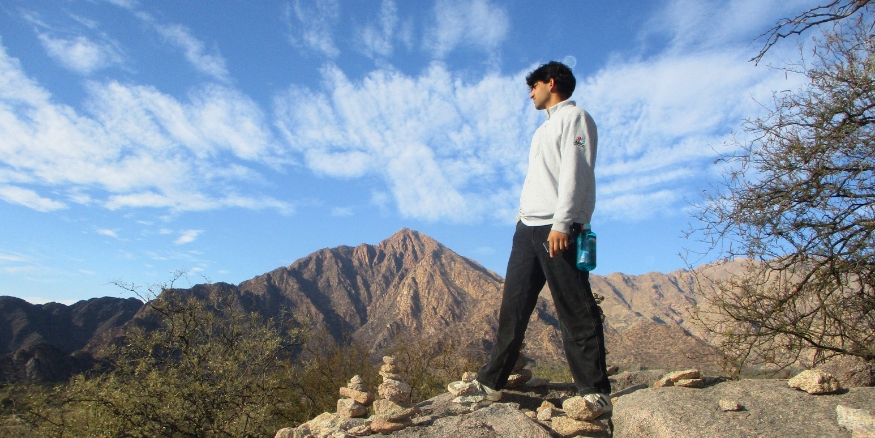
Belani in the mountains of Argentina.
Belani helped raise funds for the construction of three homes and developed data tools to identify families facing the greatest risk of housing insecurity. He also observed structural limitations, as well as distrust in the community, based on the shortcomings of past housing construction programs. “I found myself in the middle of a common challenge NGOs face: community skepticism rooted in past violations of trust and unfulfilled promises,” Belani said.
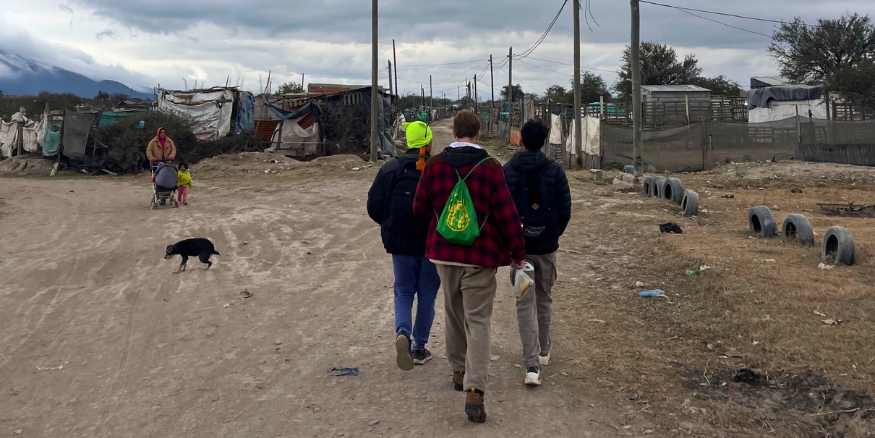
Belani in Barrio La Laguna, Argentina.
Through his experience with TECHO, Belani learned the importance of sustainability and community agency in development work. “I very quickly realized that community participation and ‘progress’ is rarely linear but rather complicated and nuanced, shaped by trust and structural limitations. It was through embracing that complexity that I explored the meaning of development as a process, as opposed to an outcome,” Belani reflected. “The perspectives and skills I gained through the program have strengthened my commitment to pursuing a career in development economics.”