
From Colombia to China: Graduate Student Photo Story Contest Winners
For our inaugural photo and video contest, we invited all graduate student fellows and grant recipients to submit entries showcasing their research abroad supported by the Institute. Winners included:
Xi Wang
PhD candidate in the Department of Sociology at the Weinberg College of Arts & Sciences
With an International Dissertation Research Grant from the Roberta Buffett Institute, Xi Wang conducted fieldwork about the vibrant psychoanalytic communities in major Chinese cities, including Chengdu, Beijing, and Shanghai. Wang’s research focuses on the transnational circulation of psychoanalysis from the West to China.
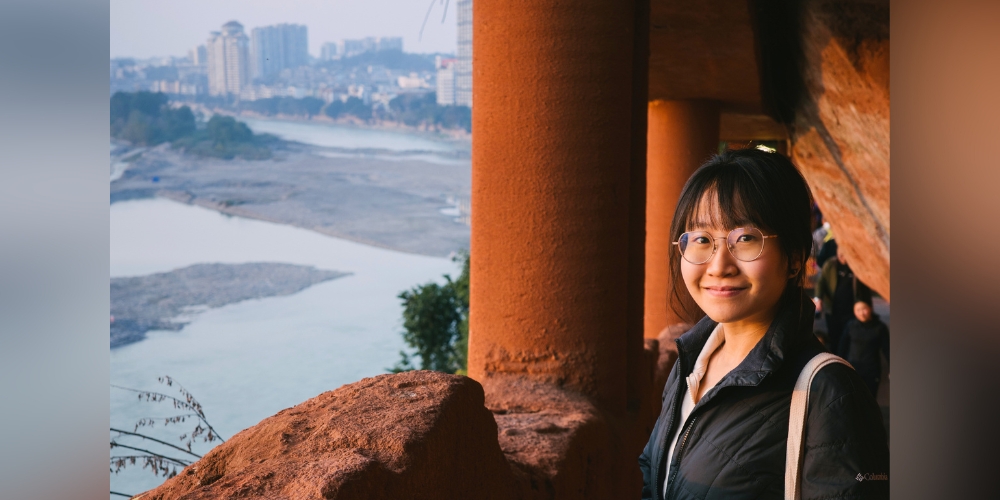
Wang on her way to a field site. (Leshan, China)
“One of the most striking moments in my fieldwork came when I asked psychoanalysts from abroad why they began teaching Chinese therapists. At first these stories sounded like chance encounters, but as I heard them again and again, a pattern emerged. What looked like coincidence was, in fact, a powerful current drawing analysts from across the world to China,” explained Wang.
“My dissertation takes this puzzle further through the lens of ‘transference’—a core psychoanalytic concept describing how feelings and expectations from earlier relationships are unconsciously projected onto new ones. I argue that transference extends beyond therapy rooms into the social field,” she posited.
In addition, her research trip enabled her to observe how psychoanalytic ideas are translated, adapted, and institutionalized in different cultural and professional contexts. She emphasized that these experiences enabled her to form “long-term, person-to-person connections” with psychoanalysts and psychotherapists across borders.
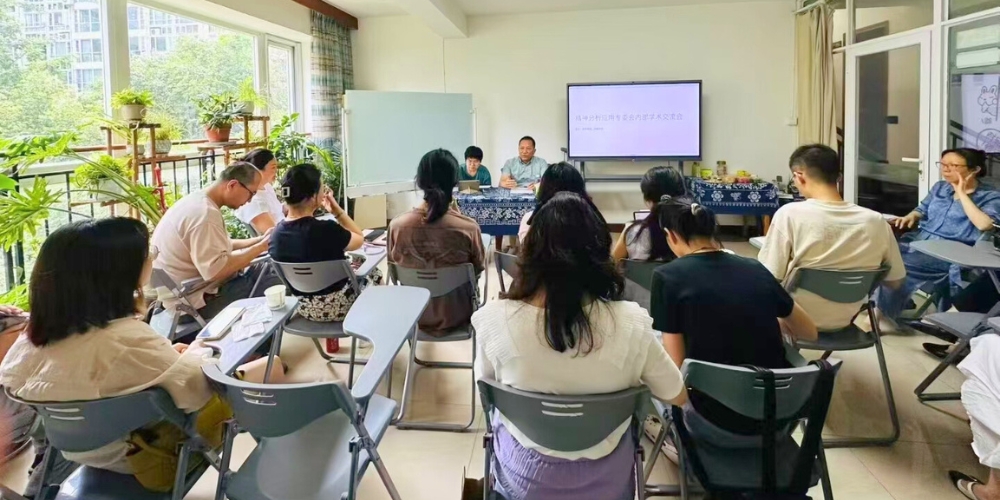
Wang conducting fieldwork at a local psychoanalytic case discussion. (Chengdu, China.)
“As both a sociologist and a trainee at the Chicago Psychoanalytic Institute, I see these exchanges as vital to building sustained, reciprocal networks that bridge scholarly inquiry and clinical practice across borders. I very much appreciate the grant’s support in helping me become a bridge—connecting social science scholars and mental health workers, and linking people from different parts of the world,” shared Wang.
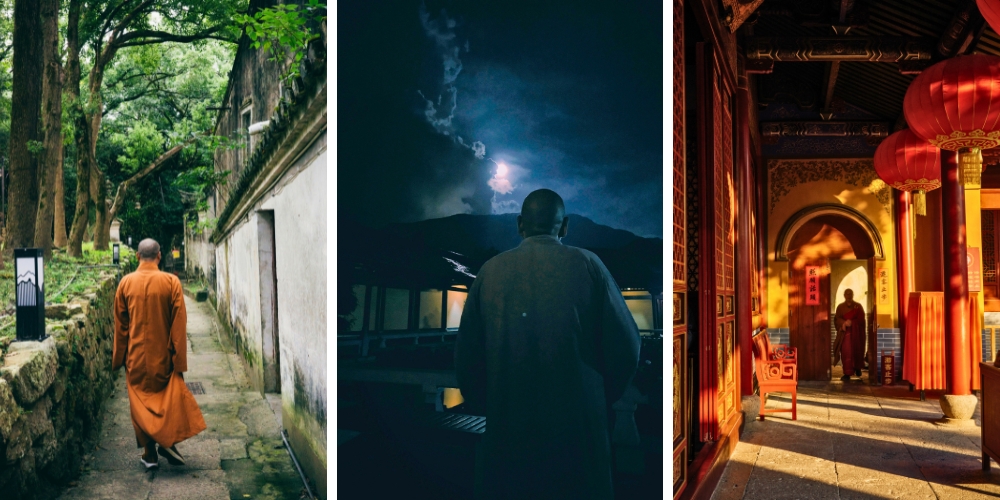
(from left to right) Wang following a monk teacher on Mount Putuo in the forest in Zhoushan, a monk teacher at Donglin Temple under the moonlight in Jiujiang, and a monk teacher on Mount Putuo at dawn in Zhoushan.
Christian Vásquez Infante
PhD candidate in the Department of Spanish & Portuguese at the Weinberg College of Arts & Sciences
With an International Conference Travel Award, Christian Vásquez Infante travelled to Colombia to work with Chocó's Reading & Writing Festival (FLECHO), a cultural and educational event founded by Colombian writer Velia Vidal. FLECHO aims to promote literature, reading, and writing within the Chocó region, the Pacific region of Colombia known for its extraordinary biodiversity, and home to the largest Afro-Colombian population in the nation. FLECHO includes events like literary exhibitions, talks, and cultural exchanges.
“Participating in this program anchored my scholarship in the everyday life of the communities my research serves,” observed Vásquez Infante. "[FLECHO organizers] taught me to lead by listening and to ground my work in reciprocity, renewing my commitment to understanding cultural rights as a lived practice rather than an abstract concept.”
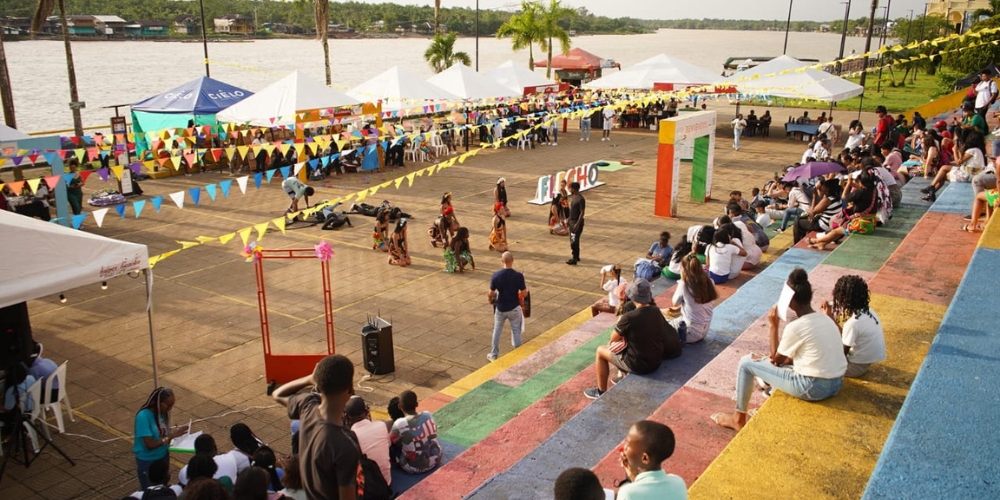
Building the festival in a public riverside space along the Río Atrato. (Chocó, Colombia)
At the Ethno-Education School of Bocas del Atrato, where students and teachers routinely commute by boat, Vásquez Infante and his FLECHO collaborators were welcomed with a student dance. “We traveled with children’s author Pilar Lozano, who read Candelario Obeso’s poem ‘Adiós’ aloud with the cadence to hold dozens of young listeners. She then introduced Obeso (1849–1884), a pioneer of Afro-Hispanic poetry who recenters river boatmen—bogas—as cultural subjects, countering the exoticizing portrayals of the nineteenth century.”
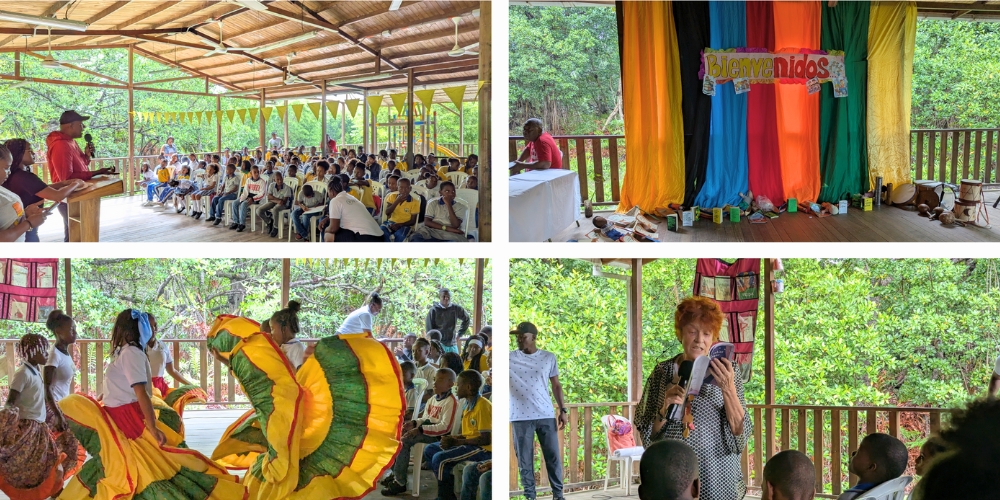
Snapshots from the shared reading session at the Ethno-Education School with children’s author Pilar Lozano. (Antioquia, Colombia)
Recounting the day, Vásquez Infante said, “Afterward, Principal Milton Durán Blandón told me visits like this ‘strengthen a culture of reading,’ helping books become everyday objects; the freely distributed volumes now circulate more among children and parents. That morning crystallized my research insight: FLECHO materially re-signifies territory, turning boats, schools, and palafitos into literary stages, and mediates national reading policy into lived, local practices—literature arriving by water and departing as shared memory.”
Previously, Vásquez Infante was awarded an International Dissertation Research Grant, which supported earlier phases of his dissertation project. “Taken together, Buffett’s support has been fundamental—accelerating my dissertation, expanding my network, and making me a more grounded, responsive scholar,” he said.
Gautam Bisht
PhD candidate in the Department of Learning Sciences at the School of Education and Social Policy
As a 2024–25 Buffett Research Fellow, Gautam Bisht conducted a research methods workshop at a small college in Uttarakhand, his home state in India where he envisions himself working long-term as a learning scientist.
Bisht’s research focuses on designing learning environments that engage with different ways of knowing both through language and literacy spaces. Inspired by scholarship on decoloniality, his research focuses on Indigenous education, migration storytelling, and local knowledge systems of the Himalayan belt.
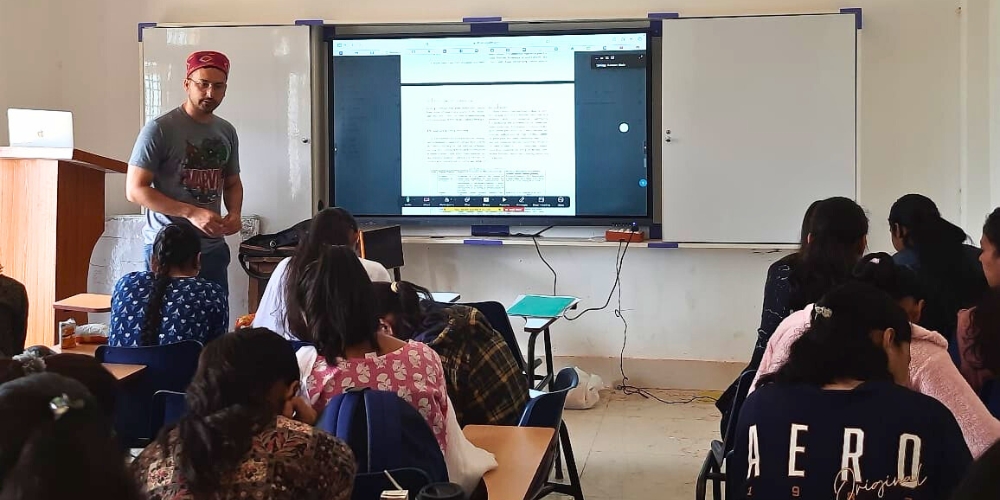
Classroom moments during the workshop for undergraduate students, which focused on locally grounded qualitative research methods. (Uttarakhand, India)
"This experience affirmed my commitment to strengthening the education system in Uttarakhand and offered a concrete path toward contributing to it," shared Bisht. “For me, the program was not just professional development but also a personal blessing, since it aligned my scholarly growth with my long-term aspiration of returning home to serve.”
The workshop underscored how important it is to adjust research methods to local cultural norms. Bisht described a moment when a student, after interviewing a shopkeeper, believed the conversation had gone “off-script.” The shopkeeper had posed a number of questions to the student. "However, upon reflection, it became evident that the shopkeeper’s questions were a natural part of the cultural exchange, where reciprocal curiosity and personal connection are valued in local conversations,” Bisth said. He noted this insight will shape the next iteration of the workshop by emphasizing that interview methods must be framed within the “cultural rhythm and values” of mountain communities.
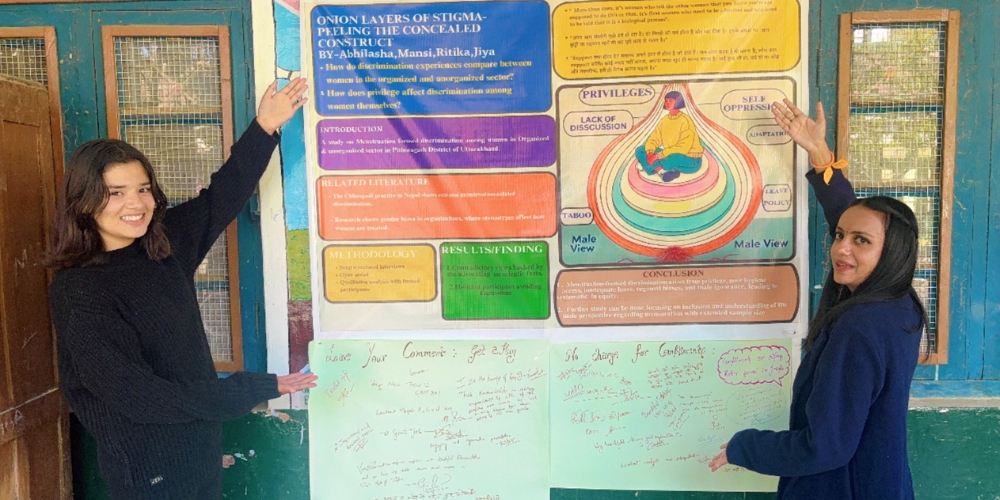
The winning research team among the undergraduates at the workshop, Abhilasha and Mansi, created a research poster on perceptions about menstruation in their local community. (Uttarakhand, India)
Ray Buckner
PhD candidate in the Department of Religious Studies at the Weinberg College of Arts & Sciences
Ray Buckner, a 2024–25 Buffett Research Fellow, developed his dissertation project by traveling to Bangkok, Thailand, where he met with and interviewed more than 30 queer and transgender Thai Buddhist artists, as well as monastics, art curators, and art patrons.
His dissertation project is an ethnographic study of 40 queer and trans Thai Buddhist artists in Bangkok who cultivate a more expansive form of Buddhism by reworking the religion’s aesthetics, materialities, and philosophies in their art-making processes.
“Receiving the Buffett Research Fellowship was a life-changing experience that helped me to grow in confidence as both a person and scholar,” he reflected. “Improving my Thai language through listening and speaking, I grew in my confidence as a scholar, shifting and expanding my methodologies and growing clearer in my interventions into the field of religious studies. Speaking with Thai artist interlocutors, I came to understand the import of Buddhist materials in their art-making practices, specifically the ways that these artists work with flowers, monastic robes, amulets, angels, and rope to forge anti-capitalist, gender-affirming, and anti-hegemonic approaches to the Buddhist path.”
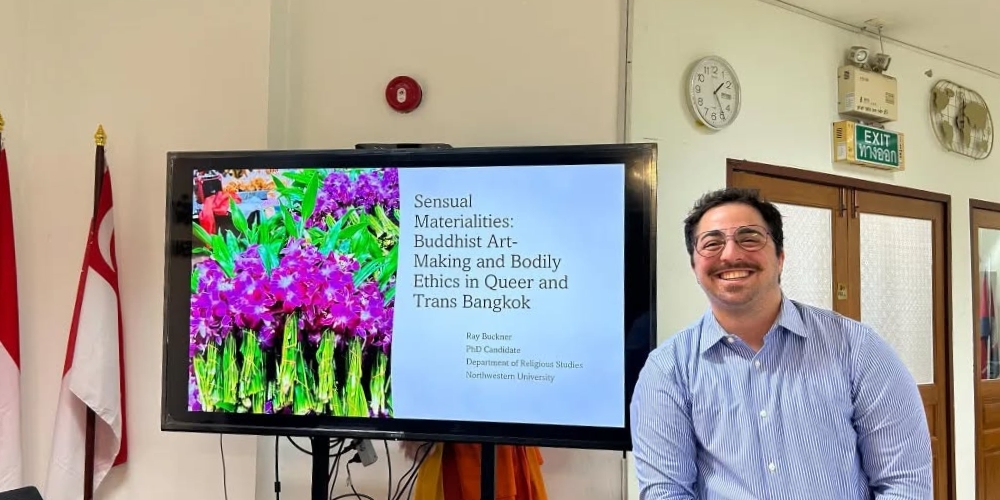
Buckner posing in front of his research presentation at a monastic university. For this presentation, he spoke with Buddhist monastics to understand their perspectives about queer and transgender art. (Bangkok, Thailand)
During his fieldwork, Buckner also encountered moments illuminating how queer and transgender Thai artists related to Buddhist materials in distinct ways. He recounted, "They slowly work with these materials, and by treating the materials with intimacy and respect, they come to forge that same respect for themselves as queer and trans people. This unexpected experience helped me to realize how queer and trans artists are forging unique relationships to Buddhist materials in ways that sometimes radically contrast with dominant forms of religious devotion in Thailand.”
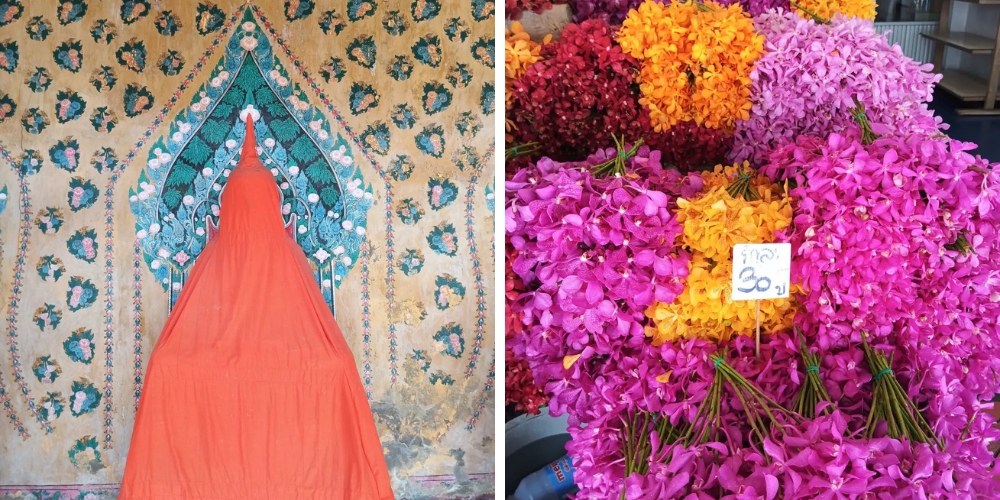
Left: A statue of the Buddha covered by a Thai monastic robe at Wat Pho during maintenance. Right: Flowers sold at Pak Khlong Talat, the city's largest flower market, for merit-making and prayer at Buddhist temples and shrines. (Bangkok, Thailand)
Craig Stevens
PhD candidate in the Department of Anthropology at the Weinberg College of Arts & Sciences
Craig Stevens, a current Buffett Dissertation Fellow, travelled to Liberia to conduct his dissertation research on African and African Diasporic material culture. Due to a combination of civil wars, a history of colonization, commercial trade, and the collection practices of Western institutions, Liberian artifacts and cultural objects are dispersed throughout the world. Stevens’ research leverages technologies like 3D digitization, virtual reality (VR), photogrammetry, and innovative curatorial strategies, to offer Liberian communities the opportunity to explain the use and meaning of these objects.
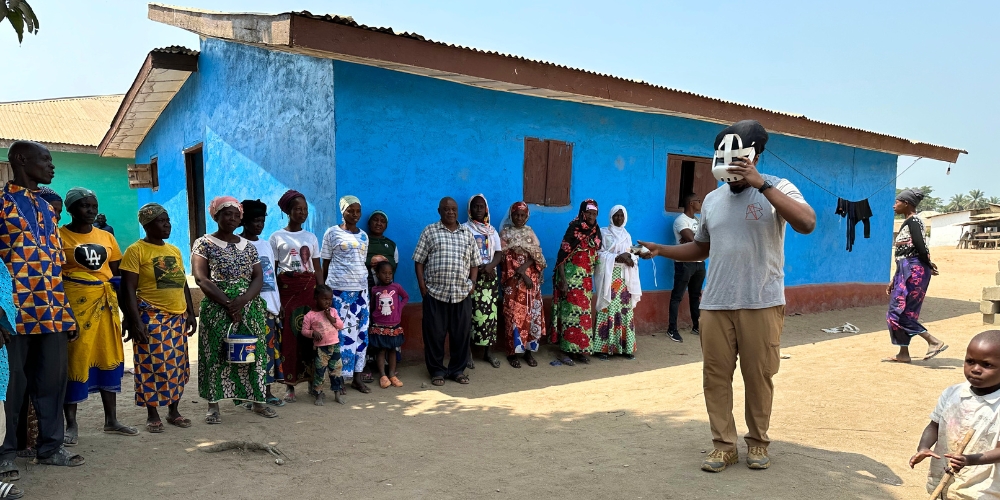
Stevens preparing for a VR demonstration as residents look on with a mix of excitement and skepticism. (Sarkonedu, Liberia)
Stevens reflected, “I’m learning that VR may be one of the most accessible interfaces we have—rooted in vision and embodied meaning-making rather than technical literacy. This experience showed me how immersive technologies can allow people marginalized by geography, education, or age to become vital participants in shaping the interpretation of their material culture.”
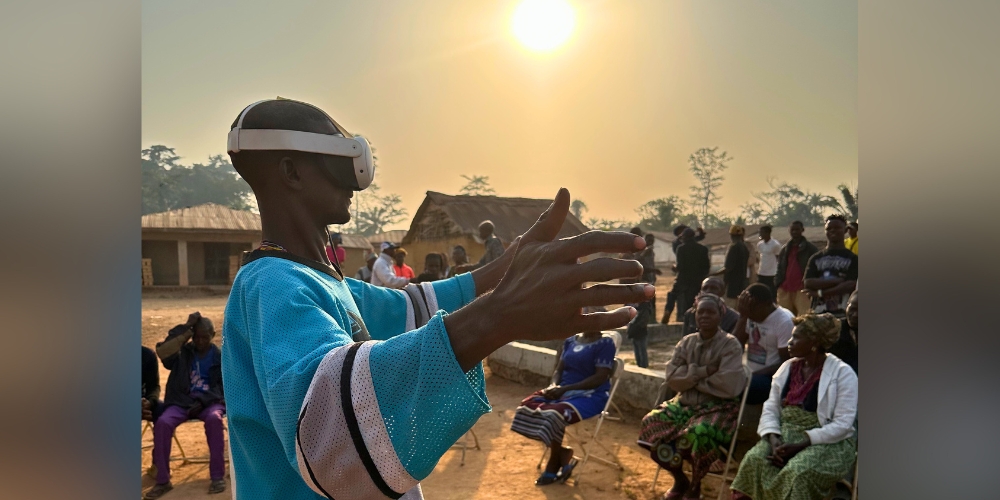
Chief Arthur Saygbah stretches his hands as he analyzes a Loma mask from the Brooklyn Museum via a VR headset. (Selega, Liberia)
As the graduate contest’s first-place winner, Stevens’ work will be featured in an upcoming Buffett Q&A article and video. Stay tuned!